 Using a transradial approach for secondary access during transcatheter aortic valve implantation (TAVI) is no different to a transfemoral strategy in terms of bleeding or vascular complications, randomised study results have shown.
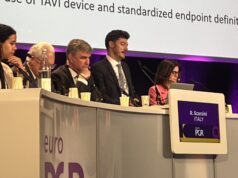
Tony Walton (Alfred Hospital, Melbourne, Australia) presented findings of the SAFER-TAVI trial during a late-breaking trials session at New York Valves 2026 (24–26 June, New York, USA), an open-label, registry-nested randomised trial taking place at three centres in Melbourne, Australia, seeking to compare the two secondary access options.
Though the femoral artery is well-established as the preferred secondary access site during TAVI, Walton detailed that secondary access via the radial artery is now more common, driven by the fact that nearly one in five TAVI-related complications occur at the secondary access site, with some observational data suggesting lower vascular complication rates with a transradial approach.
Enrolling 542 patients, 271 randomised to transradial secondary access and 271 randomised to transfemoral secondary access, SAFER-TAVI investigators looked at a composite primary endpoint of all BARC type ≥2 bleeding or vascular complications (using VARC 3 criteria) at 30 days post-TAVI, assuming an overall 40% complication rate among femoral access procedures, targeting a 30% relative risk reduction.
Walton reported that there was no difference between the two groups for the primary endpoint, which occurred in 8.5% of patients in the transradial secondary access group and 11.8% of patients in the transfemoral secondary access group. Furthermore, the transradial approach was associated with a significant reduction in secondary access site complications, which accounted for around a quarter of all vascular and bleeding complications.
There were tradeoffs observed when adopting the transradial approach, notably a higher radiation dose compared to transfemoral secondary access, and a higher rate of crossover to with transradial access. However, rates of death and stroke were similar regardless of the approach chosen, with procedure duration also broadly similar.