Routine percutaneous coronary intervention (PCI) may provide only “limited advantage” compared with medical therapy, driven primarily by unplanned revascularisations; however, physiology-guided PCI may improve outcomes in patients undergoing transcatheter aortic valve implantation (TAVI).
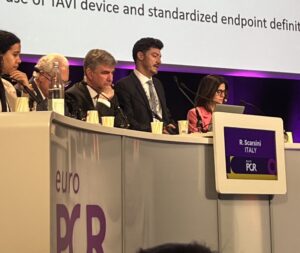
These were the findings of the ARTICA (Advanced Research on TAVI and Ischemia-guided Coronary Assessment) meta-analysis regarding four randomised controlled trials investigating management strategies of coronary disease presented by Roberto Scarsini (Azienda Ospedaliera Universitaria Integrata Verona, Verona, Italy) today at EuroPCR 2026 (19–22 May, Paris, France) during a late-breaking data session.
Contemporary randomised controlled trials with distinct designs have investigated the role of PCI compared with optimal medical treatment (OMT) in patients with coronary artery disease (CAD) undergoing TAVI. The NOTION-3 and FAITAVI trials suggested the potential benefits of physiology-guided PCI, while neutral results were observed in ACTIVATION and the TCW trial included a surgical comparator arm.
The primary endpoint was major adverse cardiac events (MACE), which included all-cause death, myocardial infarction, any coronary revascularisation and stroke at one year. The co-primary endpoint was net adverse clinical events (NACE), defined as MACE plus major bleeding at one year.
The meta-analysis included data from 1,050 patients: 439 underwent fractional flow reserve (FFR)-guided PCI, 255 underwent angiography-guided PCI and 356 patients received OMT alone.
Overall, PCI was associated with a 30% lower risk of MACE at one year compared with OMT (hazard ratio [HR] 0.70; 95% confidence interval [CI] 0.49–0.99), which was driven by a lower risk of any revascularisation (HR 0.34; 95% CI 0.14–0.80). The risk of NACE was similar with PCI and OMT, while FFR-guided PCI demonstrated a lower risk of MACE (HR 0.58; 95% CI 0.37–0.91) and NACE (HR 0.68; 95% CI 0.51–0.90) compared with OMT.
No differences in MACE or NACE were observed between angiography-guided PCI and OMT. Major bleeding occurred in 8.2% of patients with FFR-guided PCI, 13.7% with angiography-guided PCI and 12.6% with OMT.
“PCI was associated with a significant but modest risk reduction in MACE compared with medical therapy, and this was driven mainly by fewer unplanned revascularisations,” Scarsini summarised for the EuroPCR audience. “Second, FFR-guided PCI may be associated with lower MACE and NACE compared with medical therapy and compared with angio-guided PCI.”
Previous to this research paper, Scarsini described that observational studies and individual randomised trials have shown “sometimes conflicting results, with no consistent evidence supporting routine revasculariation”. When, on the other hand, physiology-guided PCI may “refine PCI targets and avoid unnecessary intervention in lesion candidates”. Scarsini asserted that, in publishing these findings, their team of investigators hope to dispel some of the “uncertainty” surrounding the management of coronary disease in TAVI candidates.