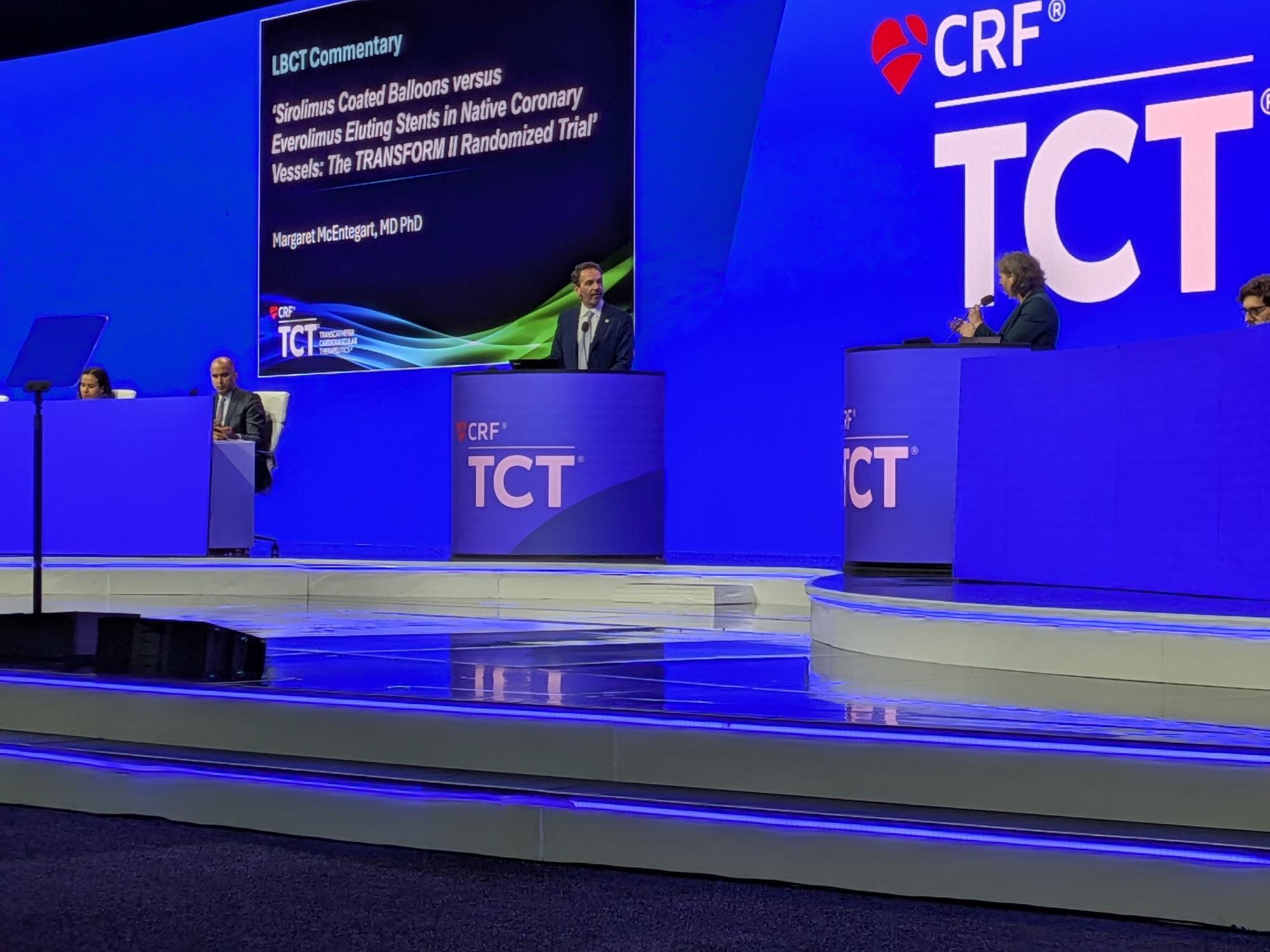
For a second year running coronary drug-coated balloon (DCB) therapies have earned a primetime slot at the Transcatheter Cardiovascular Therapeutics (TCT) meeting, with results of the TRANSFORM II study amongst the headline late-breakers presented on day two of the meeting’s 2026 instalment (31 October–3 November, San Diego, USA).
Results from the trial—an open-label, non-inferiority trial which randomised 1,842 patients to either a sirolimus-coated balloon strategy with the MagicTouch (Concept Medical) device or everolimus drug-eluting stents (EES)—demonstrated non-inferiority of the SCB strategy in treating de novo coronary lesions against a primary endpoint of target-lesion failure (TLF) at one year.
Presenting the results, Bernardo Cortese (Case Western Reserve University School of Medicine, Cleveland, USA and Fondazione Ricerca e Innovazione Cardiovascolare, Milan, Italy), the study’s principal investigator and chair, alluded to a 2026 TCT headliner—SELUTION DeNovo—positing that the results add to a growing body of studies establishing DCBs as a safe and effective alternative to stents in a selected de novo lesions.
“TRANSFORM II provides robust randomised evidence from a large, contemporary international population undergoing PCI [percutaneous coronary intervention] for de novo coronary artery disease,” said Cortese. “When considered alongside the available literature, a DCB-based approach is a safe and effective alternative to stenting in selected patients with de novo lesions.”
Like in SELUTION DeNovo, TRANSFORM II pits a sirolimus-coated DCB strategy against the current standard of care for de novo coronary lesions, stenting, with the rationale that the lack of a permanent metallic implant may reduce the annual risk of TLF seen with stents after the first year. Unlike in SELUTION DeNovo, patients in TRANSFORM II were randomised only after successful lesion preparation, defined as a residual stenosis ≤30%, TIMI grade 3 flow, and absence of dissection ≥type C.
Taking place between December 2021 and June 2025, a total of 2,699 patients were screened for enrolment in the trial, with 1,842 ultimately randomised across 53 sites spanning Europe, Southeast Asia, and Brazil. Enrolled patients were undergoing PCI for acute or chronic coronary syndrome and had a de novo lesion in a native coronary artery, with a reference vessel diameter of 2–3.5 mm and a lesion length of 50mm or less.
Baseline and angiographic characteristics were similar between the two groups, although multivessel PCI was more common in the SCB group (40.3% vs. 33.7%) and slight differences in lesion length, reference vessel diameter, and total study device length were noted between groups. Bailout stenting occurred in 7.6% of SCB-treated patients.
Cortese reported that, at 12 months, the study’s primary endpoint of TLF, comprised of cardiac death, target-vessel myocardial infarction (TV-MI), or ischaemia-driven target-lesion revascularisation, occurred in 2.1% of patients in the SCB group and 2.4% in the EES group, meeting non-inferiority criteria for the trial. At one year, the key secondary endpoint of net adverse clinical events, comprising all-cause death, myocardial infarction (MI), ischaemic stroke, or BARC major bleeding, occurred in 4.1% of the SCB group compared with 5.3% of the EES group.
Bailout stenting was required in 7.6% of patients assigned to the SCB strategy, which Cortese said was consistent with other DCB studies.
The investigator-driven study was sponsored by Fondazione Ricerca e Innovazione Cardiovascolare and received an unrestricted grant from Concept Medical. The results have been accepted for publication in The Lancet.