This advertorial is sponsored by Johnson & Johnson Medtech

Leah Raj (Vanderbilt University Medical Center, Nashville, USA) discusses the role of Shockwave Intravascular Lithotripsy (IVL; Johnson & Johnson MedTech) in the modification of eccentric calcium arcs and non-eruptive calcified nodules (CN), and reflects on how the third generation coronary IVL catheter—Shockwave C2 Aero—brings advancements to the hands of physicians.
What makes eccentric calcium and CN challenging to modify?
We tend to see a lot of patients with these complex calcium morphologies as our patient population ages. Calcified lesions with challenging calcium morphology—specifically eccentric calcium arcs and CN—are associated with less acute gain, asymmetrical stent geometry, and stent under expansion as compared to larger calcium arcs.1,2 Therefore, it’s essential to not only appropriately modify eccentric calcium and, but to do so in a predictably safe manner given the risks associated with older patient populations.
What role does intravascular imaging (IVI) play in identifying these calcium types?
I’m a firm believer that routine use of IVI helps guide how we treat calcified lesions. It is understood that calcium burden is underestimated when using fluoroscopy alone, and this notion is further exacerbated when identifying smaller calcium arcs and CN.3 IVI techniques such as intravascular ultrasound (IVUS) and optical coherence tomography (OCT) not only provide a more complete “picture” of the amount of calcium present within the target lesion but also provides the calcium depth, arc, length and presence of CN to help inform the most appropriate treatment strategy. IVI also informs the reference vessel diameter so that you can appropriately size your calcium modification tool to ensure adequate apposition against the vessel wall.
Before you had Shockwave IVL, how would you typically approach eccentric calcium and CN?
Prior to the introduction of Shockwave IVL, eccentric calcium and CN were treated with standalone with, or a combination of, non-compliant (NC) balloons, speciality balloons and atherectomy strategies. Balloon-based strategies have mechanistic limitations when it comes to the modification of smaller calcium arcs and CN. Rather than modifying the calcium, the balloon expands via the path of least resistance; i.e. tissue and increase the risk of dissection and perforations at the calcium and tissue interface. Atherectomy also has mechanistic limitations considering that the burr may “miss” the calcific areas within the target lesion due to wire-bias.
Since the introduction of Shockwave IVL my approach for treating balloon-crossable calcific target lesions with eccentric calcium and CN is consistent: I start with an undersized NC balloon to assess how the lesion responds. I then utilise IVI to see if there are any visible calcium fractures and confirm the calcium burden. If severe calcium is present without any signs of modification, I will generally deliver a 1:1 sized Shockwave IVL coronary catheter and deliver therapy. From there I reassess the lesion using an NC balloon and/or repeat IVI. In the rare instances the result is still not satisfactory; I will consider utilising an undersized cutting balloon.
What is it about Shockwave IVL that is distinctive in modifying eccentric calcium and CN?
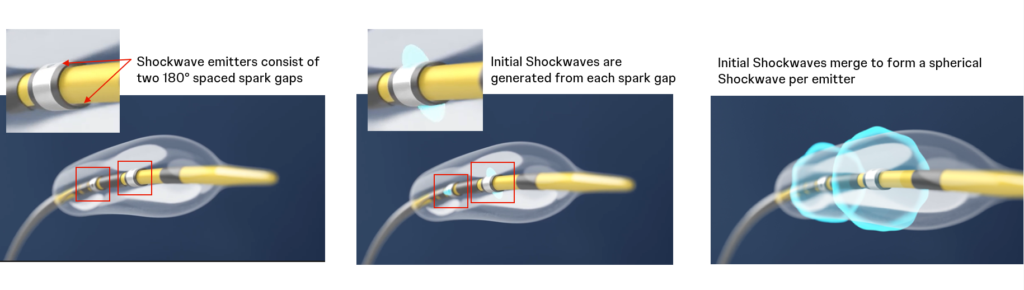
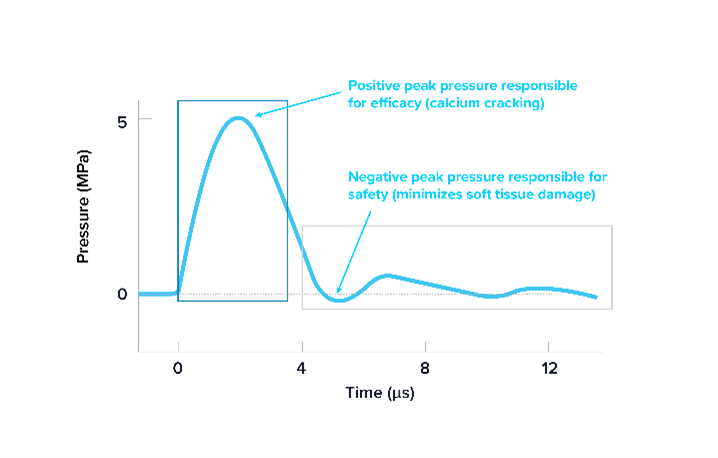
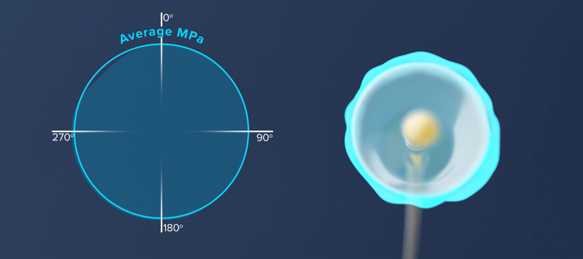
Shockwave IVL is distinct in how it modifies eccentric calcium and CN due to its predictable safety and consistent efficacy. The therapeutic payload of Shockwave IVL is the energy-based generation of tuned ultrasonic acoustic pressure waves—or Shockwaves—whose unique acoustic waveform prioritise safety without tradeoffs for efficacy [Figure 1].4 Safety is further facilitated due to the low pressures by which Shockwave IVL is inflated to [2-4 atm] during therapy delivery. These two elements likely explain perforation with Shockwave IVL is unlikely. Efficacy of Shockwave IVL in eccentric calcium and CN is facilitated by its consistent, circumferential acoustic output. A spherical Shockwave is formed from each emitter when the initial Shockwaves produced from each of the two 180-degree spaced spark gaps merge [Figure 2]. The acoustic output of the subsequent Shockwave produced is measured to be consistent circumferentially with no quadrants lacking an acoustic output less than the threshold for calcium modification, which is ideal for the treatment of eccentric calcium and CN that may present in any given area of the vessel [Figure 3].5 My experience with the safety and efficacy of Shockwave IVL within eccentric calcium and CN matches with published clinical evidence demonstrating consistent stent expansion, minimum stent area and low rates of complications across all types of calcium. 6,7
What aspects of Shockwave C2 Aero are most relevant to the way you approach eccentric calcium or CN?
Shockwave C2 Aero is Shockwave IVL’s third generation coronary IVL catheter that has reset my expectations of balloon-based IVL deliverability. Due to its advances in deliverability, I rarely utilise guide extensions prior to Shockwave IVL therapy to facilitate deliverability of the catheter to a target lesion. I have also found that the balloon rewraps much better than the prior version, allowing me to better reposition the catheter between cycles in specific areas within the lesion or to use in multiple lesions to ensure complete calcium modification. Finally, it’s faster. Shockwave C2 Aero has 50% less wait time between pulse cycles cutting overall treatment time by 24%.8 In complex percutaneous coronary intervention (PCI), you’re spending so much time trying to modify difficult lesions, so anything that makes the process more efficient is valuable. This is why I am looking forward to the introduction of Shockwave C2 Aero Fly—Shockwave IVL’s fourth generation coronary IVL catheter—which includes all advancements mentioned above with 2x faster pulsing.
What is your practical advice for treating eccentric calcium and CN with Shockwave IVL?
I would emphasise three things: confirm what you are treating with IVI, size the Shockwave IVL catheter appropriately, and confirm appropriate lesion preparation after treatment prior to definitive therapy.
References
- Hoffmann R, Mintz GS, Popma JJ, et al. Treatment of calcified coronary lesions with Palmaz-Schatz stents. An intravascular ultrasound study. Eur Heart J. 1998;19:1224–1231. doi:10.1053/euhj.1998.1028
- Jinnouchi H, Sakakura K, Taniguchi Y, et al. Clinical Outcomes and Unique Restenosis of Calcified Nodule in Heavily Calcified Coronary Artery. J Atheroscler Thromb. 2023;30:649-62.
- Gao XF, Ge Z, Kong XQ, et al. 3-year outcomes of the ULTIMATE trial comparing intravascular ultrasound versus angiography-guided drug-eluting stent implantation. JACC Cardiovasc Interv. 2021;14:247-257. doi: 10.1016/j.jcin.2020.10.001
- Kereiakes, D, Virmani, R, Hokama, J. et al. Principles of Intravascular Lithotripsy for Calcific Plaque Modification. Figure 1E. J Am Coll Cardiol Intv. 2021 Jun, 14 (12) 1275–1292.
- Based on by quadrant average acoustic output of 28 measurements at balloon edge adjacent to emitter. IEC standards 62127 & 61846
- Ali ZA et al, Impact of Calcium Eccentricity on the Safety and Effectiveness of Coronary Intravascular Lithotripsy: Pooled Analysis From the Disrupt CAD Studies. Circulation CV Interventions, 2023;16:e012898.
- Ali ZA et al, Outcomes of coronary intravascular lithotripsy for the treatment of calcified nodules: a pooled analysis of the Disrupt CAD Studies. EuroIntervention. 2024;20e1454-e1464
- Assuming one catheter is used in the procedure. Follow IFU.
Disclosures: Dr Raj is a paid consultant for Johnson & Johnson MedTech. The thoughts and views expressed are of their own opinions and do not necessarily represent Johnson & Johnson MedTech.
In the US: Rx Only.
Prior to use, please reference Instructions for Use for information on indications, contraindications, warnings, precautions, and adverse events. www.shockwavemedical.com/IFU
Product availability may vary by country.
SPL 83839 Rev. A