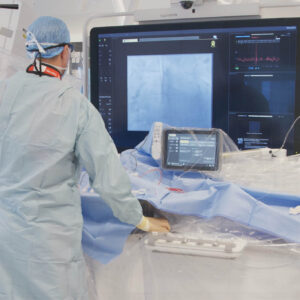
Royal Philips has announced the launch of SmartIQ, which the company describes as a breakthrough coronary imaging technology for its Azurion image-guided therapy.
Philips notes in a press release that SmartIQ, which has been developed in collaboration with leading cardiovascular centres, is designed to address “one of the field’s most fundamental challenges”: the trade-off between image quality and radiation exposure for patients and clinical staff.
The company continues that SmartIQ aims to empower clinicians with “exceptional” image quality, enabling them to see exactly what they need, while it aims to provide reassurance that X-ray dose and contrast levels are optimised.
“With this new imaging technology, we can go really low in dose and achieve even better image quality. It’s a win-win,” said interventional cardiologist Mark Winkens (Elisabeth-TweeSteden Hospital, Tilburg, Netherlands).
Philips is currently showcasing SmartIQ at EuroPCR 2026 (19–22 May, Paris, France), where attendees can experience the technology firsthand and hear directly from early clinical adopters. During dedicated clinical sessions, clinicians will share initial case experiences and present real-world multicentre results.
The first blinded clinical pilot study evaluating SmartIQ was recently published in Journal of the Society for Cardiovascular Angiography & Interventions. The study suggests that the algorithm scored higher on image quality and was preferred in the vast majority of blinded comparisons, while maintaining or lowering radiation and contrast dose.
The technology builds on Philips’ ClarityIQ platform, which has previously been associated with radiation exposure reductions between 23% and 83%, depending on the clinical area. In parallel, the ongoing RADIQAL trial is designed to assess the impact of SmartIQ on radiation dose compared to ClarityIQ while maintaining procedural performance. The study has recently reached 60% of total enrolment and completed enrolment at European sites.
According to Philips, SmartIQ “represents the next step forward” in image quality and dose management for coronary imaging. It includes an ultra-low dose protocol for coronary procedures that employs over 50% less X-ray radiation dose compared with the lowest dose settings available with Philips ClarityIQ. This setting aims to enable acquisition of coronary cine runs at fluoroscopy dose levels, depending on system and clinical conditions.
“Image quality is the foundation of every decision we make in the cath lab. SmartIQ has genuinely surprised us. It delivers the clarity we need at very low radiation dose levels,” said interventional cardiologist Nicolaj Brejnholt Støttrup (Aarhus University Hospital, Aarhus, Denmark).