 Combining rotational atherectomy and intravascular lithotripsy (IVL) before percutaneous coronary intervention (PCI) may aid stent expansion in nodular coronary calcium.
This is according to the findings of a randomised study—NODULE-SHOCK—conducted at the Mount Sinai Hospital (New York, USA) and enrolling patients with severely calcific coronary artery disease. Investigators claim that using the combined treatment approach yielded a 19% larger stent area than with the standard, single treatment.
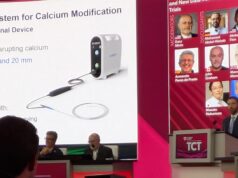
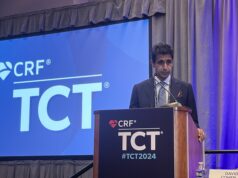
Annapoorna Kini (Icahn School of Medicine at Mount Sinai, New York, USA) presented the results of the study at the Transcatheter Cardiovascular Therapeutics (TCT) conference (31 October–3 November, San Diego, USA), with the findings simultaneously published in JACC: Cardiovascular Interventions.
“Calcified nodules are among the most challenging coronary lesions because their hard, irregular structure prevents stents from fully expanding. Our study introduces the ‘Shave and Shake’ concept: using rotational atherectomy to modify protruding calcium, followed by lithotripsy to fracture deeper calcium,” said Kini. “Combining these complementary technologies resulted in larger and more uniformly expanded stents. This supports taking a more personalised approach for these complex cases, based on the type of calcium, rather than treating all calcified lesions the same way.”
Kini and her research team tested whether using rotational atherectomy plus IVL could achieve better stent expansion than IVL alone for patients with calcified nodules. The team also tested whether delivering additional IVL pulses provided further benefit. NODULE-SHOCK is the first randomised trial specifically analysing these techniques in patients with calcified nodules.
Researchers assessed coronary calcium nodules using optical coherence tomography (OCT), an intravascular imaging technique.
Among 66 patients with calcified nodules, 33 were assigned to rotational atherectomy plus IVL and 33 to IVL alone. Researchers used OCT to characterise the calcium nodules before treatment, assess its response to the treatment techniques, and measure the final stent expansion.
The final stent area averaged 7.41mm² with rotational atherectomy plus IVL versus 6.23mm² with IVL alone. Stents in the combined therapy group were also more circular and symmetric. Procedural success was 100% in the combined therapy group versus 97% with IVL alone.
The study also looked at a different cohort of patients with severely calcified lesions but without calcified nodules. All patients were treated with IVL alone, and researchers wanted to test whether additional IVL pulses were effective in improving stent expansion. Among a total of 54 enrolled patients, 27 patients were assigned to a maximum-pulse IVL strategy (up to 120 pulses) and 27 to physician-selected IVL dosing (approximately 75-80 pulses). Researchers found that extra pulses did not improve stent expansion. More specifically, patients in the maximum-pulse group received an average of 114 pulses, compared with 75 in the physician-selected group, but the final stent area was similar (5.5 versus 5.56mm²).
Across both cohorts in the entire study, investigators reported no deaths, heart attacks, repeat procedures involving the treated artery, or stent thromboses during the first 30 days.
“The important message from NODULE-SHOCK is that more treatment is not always better, but choosing the right treatment for the right type of calcium may be,” says Kini. “Our findings support moving toward more personalized coronary interventions, guided by the characteristics of each patient’s calcium deposits.”
One-year follow-up is ongoing. Larger, randomised trials at multiple centres are needed to determine whether greater stent expansion improves longer-term clinical outcomes, the investigators say.