This advertorial is sponsored by Vesalio.

Could enVast (Vesalio) thrombectomy followed by drug-coated balloon (DCB) angioplasty pave the way for a “leave-nothing-behind” strategy in large thrombus burden (LTB) patients? Wijnand den Dekker (Erasmus University Medical Center, Rotterdam, the Netherlands) shares his perspective.
Management of LTB in patients with ST-elevation myocardial infarction (STEMI) remains challenging because of the increased risk of distal embolisation, microvascular obstruction, and adverse clinical outcomes. Manual aspiration thrombectomy may reduce thrombus burden, but its routine use has not demonstrated a consistent clinical benefit in large randomised controlled trials. The TAPAS trial initially suggested improved myocardial reperfusion and clinical outcomes,1 but both the TASTE and TOTAL trials failed to demonstrate a significant reduction in major clinical events.2,3 Moreover, the TOTAL trial identified an increased risk of stroke associated with routine thrombectomy. Similarly, an individual-patient meta-analysis showed no reduction in cardiovascular mortality.4
A sub-analysis of the TOTAL trial provides further insight into the potential limitations of manual aspiration thrombectomy.5 Large residual thrombus burden was observed in approximately 35% of patients following aspiration thrombectomy, and these patients had a significantly higher incidence of adverse cardiovascular outcomes at 180 days than those with small or no residual thrombus. These findings suggest that conventional aspiration techniques may not achieve sufficient thrombus removal in a substantial proportion of patients.
Persistent thrombus may contribute to ongoing distal embolisation, impaired microvascular perfusion, and subsequent myocardial injury, potentially limiting the clinical benefit of the procedure. Although residual thrombus burden cannot, by itself, explain the overall neutral results of the TOTAL trial, these findings highlight the importance of distinguishing between performing thrombectomy and achieving effective thrombus removal. They also support further investigation into alternative or adjunctive strategies capable of more effectively reducing thrombus burden in selected high-risk patients with STEMI.
Against this backdrop, the clinical need for an effective and reliable tool that provides comprehensive clot removal remains critical. enVast offers a promising approach by mechanically engaging and retrieving thrombotic material of all morphologies and volume. Importantly, the recently published randomised NATURE trial provides encouraging evidence for this technique. Among 156 patients with STEMI and LTB, enVast-assisted thrombectomy followed by conventional percutaneous coronary intervention (PCI) resulted in a significantly lower infarct size, assessed by creatine kinase-MB release, compared with conventional PCI alone. Exploratory cardiac magnetic resonance findings also demonstrated a smaller infarct size in the thrombectomy group.6
Beyond thrombus removal, an additional consideration is the treatment of the underlying culprit lesion. DCB angioplasty offers a “leave-nothing-behind” strategy, delivering an antiproliferative drug without leaving a permanent metallic implant.
In carefully selected lesions, enVast thrombectomy followed by a DCB-only angioplasty may offer a promising stent-free treatment strategy, provided adequate vessel expansion is achieved with no significant residual stenosis or thrombus, vessel recoil, or flow-limiting dissection. Supported by intravascular imaging, this individualised approach to lesion treatment may offer an alternative for selected STEMI patients with LTB and warrants further studies to establish its safety, efficacy, and role in contemporary clinical practice.
Case report
A 49-year-old female presented with sudden-onset severe chest pain. Her medical history included non-insulin-dependent diabetes, hypercholesterolaemia, hypertension and smoking. Her electrocardiogram showed sinus rhythm of 52 beats per minute (beats/min) with anterolateral STEMI. Upon admission her blood pressure was 166/88mmHg, and her heart rate was 55 beats/min. The patient was treated with aspirin, prasugrel and heparin and scheduled for urgent coronary angiography.
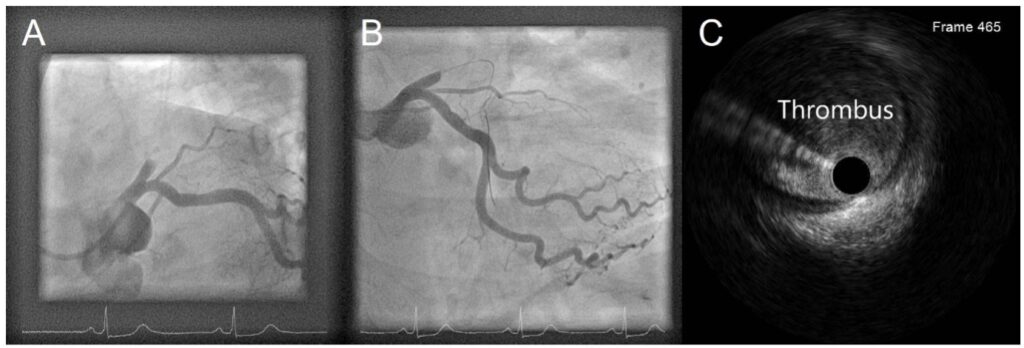
Coronary angiography showed wall irregularities in the right coronary, left main and circumflex arteries along with a thrombotic occlusion of the proximal left anterior descending artery (LAD), with Thrombolysis in Myocardial Infarction (TIMI) 0 flow (Figure 1A). Despite successful wiring of the LAD with a workhorse coronary guidewire, antegrade flow was not observed, consistent with a grade 5 large thrombus burden. Two runs of manual aspiration thrombectomy were performed with good yield, followed by predilatation with a 2mm semi-compliant balloon. However, antegrade flow remained absent (Figure 1B). Imaging with intravascular ultrasound (IVUS) confirmed that the wire was positioned within the true lumen, but revealed a persistent large thrombus burden. Given the absence of antegrade flow (Figure 1C) despite these interventions, we decided to use enVast coronary clot retriever to remove the thrombus.
Following the first deployment and retrieval of a 6x35mm enVast, a significant amount of red thrombus was extracted (Figure 2B), finally restoring antegrade flow. We decided to perform an additional pass with enVast to retrieve the remaining thrombus (Figure 2C), achieving complete angiographic thrombus clearance and TIMI III flow (Figure 2D). IVUS confirmed the absence of residual thrombus and identified plaque rupture as the underlying cause (Figure 2E). Given the large minimal luminal area and absence of residual thrombus, we opted for a DCB rather than stenting with a drug-eluting stent.
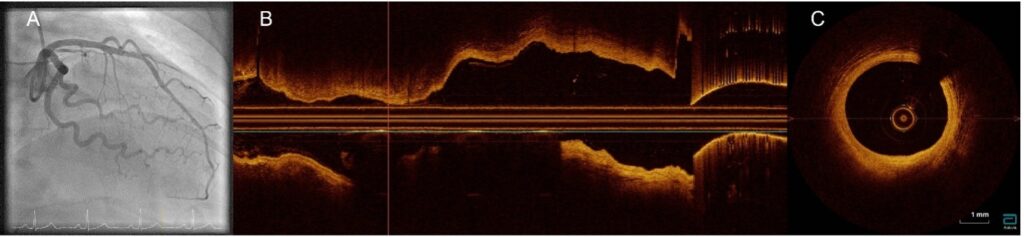
The postoperative course was uneventful, and the patient was discharged to home two days later. Nine months after her myocardial infarction, we performed a control angiogram which showed a patent LAD without stenosis (Figure 3A). This was confirmed with intravascular imaging by optical coherence tomography (Figure 3B and 3C).
This case demonstrates the potential of enVast thrombectomy to achieve complete thrombus removal and facilitate a “leave-nothing- behind” DCB strategy for carefully selected lesions.

References:
- Svilaas T, Vlaar PJ, Horst IC van der, Diercks GFH, Smet BJGL de, Heuvel AFM van den, et al. Thrombus Aspiration during Primary Percutaneous Coronary Intervention. New England Journal of Medicine. 2008 Feb 7;358(6):557–67. doi:10.1056/ NEJMoa0706416
- Fröbert O, Lagerqvist B, Olivecrona GK, Omerovic E, Gudnason T, Maeng M, et al. Thrombus Aspiration during ST-Segment Elevation Myocardial Infarction. New England Journal of Medicine. 2013 Oct 24;369(17):1587–97. doi:10.1056/ NEJMoa1308789
- Jolly SS, Cairns JA, Yusuf S, Meeks B, Pogue J, Rokoss MJ, et al. Randomized Trial of Primary PCI with or without Routine Manual Thrombectomy. New England Journal of Medicine. 2015 Apr 9;372(15):1389–98. doi:10.1056/NEJMoa1415098
- Jolly SS, James S, Džavík V, Cairns JA, Mahmoud KD, Zijlstra F, et al. Thrombus Aspiration in ST-Segment–Elevation Myocardial Infarction. Circulation. 2017 Jan 10;135(2):143–52. doi:10.1161/CIRCULATIONAHA.116.025371
- Alkhalil M, Kuzemczak M, Zhao R, Kavvouras C, Cantor WJ, Overgaard CB, et al. Prognostic Role of Residual Thrombus Burden Following Thrombectomy: Insights From the TOTAL Trial. Circ Cardiovasc Interv. 2022 May;15(5):e011336. doi:10.1161/CIRCINTERVENTIONS.121.011336 PubMed PMID: 35580203
- Valgimigli M, Frigoli E, Landi A, Covani M, Biscaglia S, Cuculi F, et al. Stent Retriever Thrombectomy in Patients With Myocardial Infarction: The Open-Label, Multicenter NATURE Superiority Trial. JACC. 2026 Aug 29. doi:10.1016/j. jacc.2026.08.034
Wijnand den Dekker is an interventional cardiologist at Erasmus University Medical Center, Rotterdam, the Netherlands.
Disclaimer: The views expressed in this article are those of the physician and may not represent the views of Vesalio. enVast is both CE marked and US Food and Drug Administration (FDA) cleared. Visit www.Vesalio.com for indications, safety & warnings.