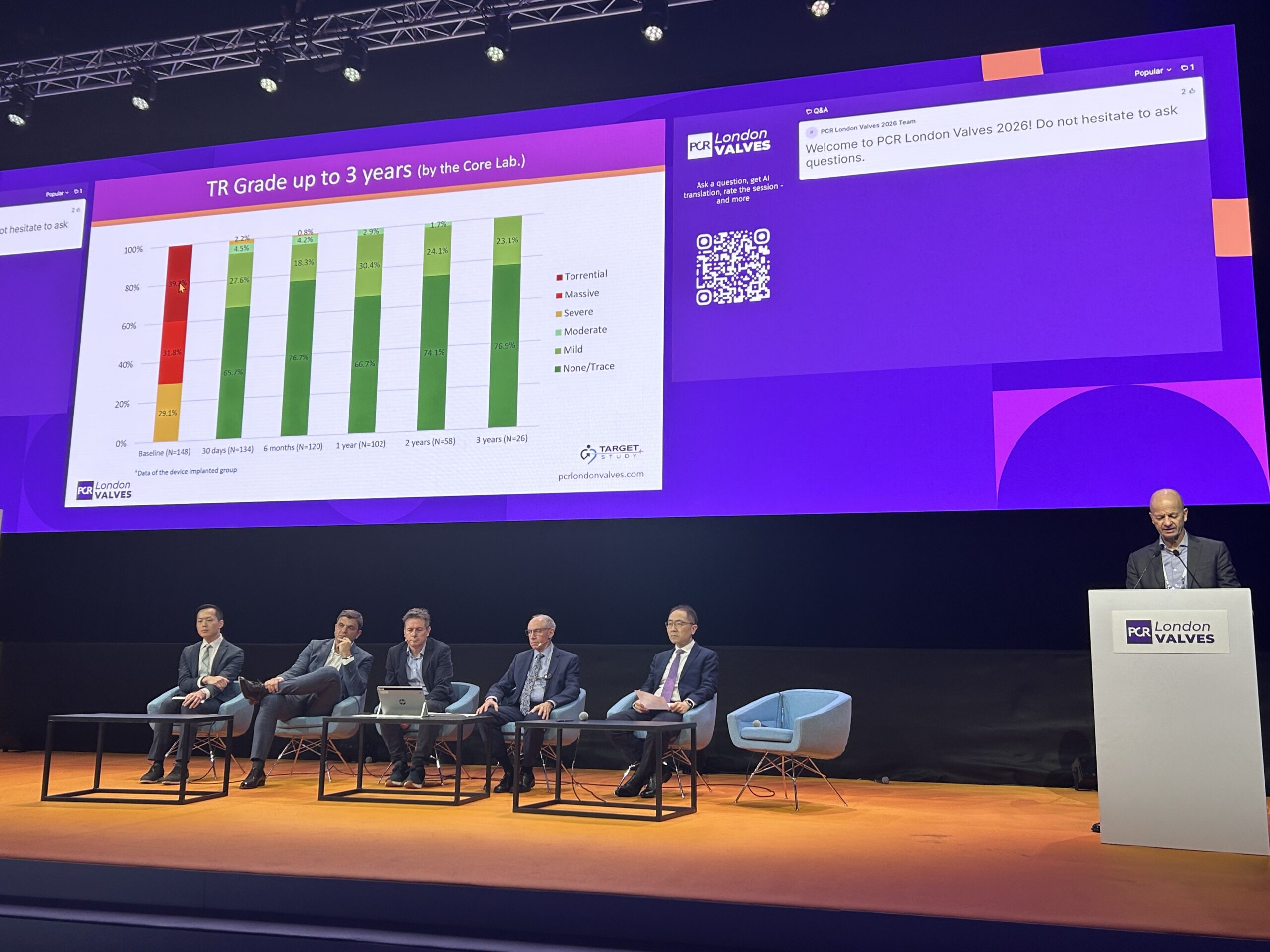
Latest data from the TARGET study—assessing the safety and efficacy of the Cardiovalve (Venus MedTech) transcatheter tricuspid valve replacement (TTVR) system—have been presented at PCR London Valves (22–24 November, London, UK).
The latest data from the multicentre, prospective, single-arm, open-label clinical trial, which include some clinical outcomes out to three years, were delivered by Georg Nickenig (University Hospital Bonn, Bonn, Germany) on behalf of the TARGET study investigators during a hotline trials session at the conference.
Nickenig reported that the study enrolled 157 symptomatic patients (148 implanted subjects) with at least severe tricuspid regurgitation (TR) who were at high risk for open-heart surgery. The patient population was highly comorbid, with a mean age of 78 years, 71% female, 99% presenting with secondary TR and nearly 40% having torrential TR.
At 30 days, the study met its primary performance endpoint of successful implantation with ≤2+ TR. The elimination of TR was sustained up to three years, with 76.9% of patients achieving none/trace TR at the three-year mark.
Furthermore, significant improvements in six-minute walk test (6MWT) were observed, with a mean increase of +42 meters after one year, and patients reported substantial improvements in their health status, with a +20-point increase in the Kansas City Cardiomyopathy Questionnaire (KCCQ) score at one year.
A marked shift toward New York Heart Association (NYHA) class I–II was observed over time, with 80% of patients in class I or II at three years, compared to 39.9% at baseline. Additionally, the therapy demonstrated positive reverse right heart remodelling, with mean reductions at three years in inferior vena cava (IVC) diameter (-25%), mid right ventricular end-diastolic diameter (RVEDD, -22%) and basal RVEDD (-11%).
The primary safety endpoint, a composite of major adverse events (MAEs) at 30 days per Tricuspid Valve Academic Research Consortium (TVARC) definition was met, demonstrating a favourable safety profile in this high-risk population. At 30 days, all-cause mortality was 5.7%, heart failure (HF) rehospitalisation was 1.9% and major access site and vascular injury requiring surgical intervention was 5.1%.
Notably, the study demonstrated favourable safety improvements with the enhanced delivery system (DS) compared to the first deneration delivery system, including reduced rates of major bleeding (5% vs. 21%) and major vascular complications (3% vs. 8.8%).
“The results of the Cardiovalve study are highly encouraging, demonstrating strong efficacy in tricuspid regurgitation reduction and a favourable safety profile, particularly with the new device iteration,” Nickenig said. “The long-term findings represent an important step forward, offering hope that patients suffering from TR will soon have access to a novel and effective treatment option.”
The Cardiovalve TR System is in the final stages of preparation for regulatory milestones, with potential EU commercialisation expected in the second half of 2027.