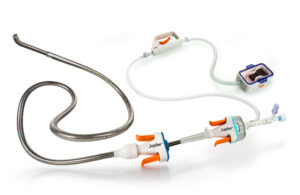
Jupiter Endovascular has revealed findings from new analyses of its SPIRARE II pivotal trial showing that restoring normal pulmonary artery pressure with the Vertex thrombectomy system tracked with right heart recovery at 48 hours. The analysis also demonstrated that reaching the lower lobes of the lungs with the system was associated with greater haemodynamic restoration. The data was presented at the Transcatheter Cardiovascular Therapeutics (TCT) conference (31 October–3 November, San Diego, USA) by Sripal Bangalore (NYU Grossman School of Medicine, New York, USA).
In pulmonary embolism (PE), right ventricular (RV) failure, rather than the clot itself, is the primary driver of mortality. While most PE trials have relied on measuring RV/LV ratio—or heart size—solely with computed tomography (CT) imaging, the 123-patient SPIRARE II trial also measured the physiology directly. Invasive right heart catheterisation was used to record pressures in the heart and lungs before and immediately after treatment in all 123 patients, along with independent core laboratory echocardiography which recorded RV function at baseline and 48 hours.
In a new post-hoc analysis, 93% of patients treated with the Vertex system showed a reduction in mean pulmonary artery pressure, and half ended the procedure with pressures in the normal range (mean ≤20mmHg). At 48 hours, patients who reached normal pressure were more likely to have RV recovery, as defined by RV-pulmonary artery coupling, which is an established marker of right heart function. The findings add to previously reported results in which the Vertex system reduced mean pulmonary artery pressure by an average of 8.5mmHg (29%), immediately relieving strain on the right ventricle, with consistent results across all 19 sites.
This analysis also showed that accessing a greater number of vessels during a procedure, including the lower lung lobes, resulted in a higher likelihood of pressure normalisation. While exploratory, these post hoc findings suggest the lower lobes may be an important target for restoring normal haemodynamics.
“What stands out is that an intraprocedural normalisation of mean pulmonary artery pressure is one of the indicators of how well the right ventricle functions two days later,” said Bangalore. “It also raises an important question for our field about how complete we should be with clot removal, including targeting the lower lobes, and how that shapes a patient’s recovery.”
According to the company, reaching the lower lobes involves navigating a dilated, struggling right heart and holding position deep in the pulmonary arteries. Built on the company’s proprietary Transforming Fixation (TFX) technology, the Vertex catheter used in the Vertex system is designed to navigate flexibly through the right heart and stabilise on demand in the pulmonary arteries for controlled intervention, allowing physicians to redirect the catheter from lobe to lobe without re-crossing the pulmonic valve. By reducing the need to continually manage catheter position and stability, TFX allows physicians to focus more on delivering therapy than on maintaining access. In SPIRARE II, 83% of cases did not require re-crossing of the pulmonic valve, and no patient received adjunctive thrombolytics.
“SPIRARE II was built around the outcome that matters most to patients with PE: recovery of the right heart,” said Catalin Toma, chief medical officer of Jupiter Endovascular and global co-principal investigator of SPIRARE II. “Measuring physiology directly in every patient, rather than relying on imaging alone, gives us a clearer view of that recovery. TFX was designed to give physicians stable, controlled access to hard-to-reach anatomy, and these findings support our belief that this is where meaningful haemodynamic gains are made.”