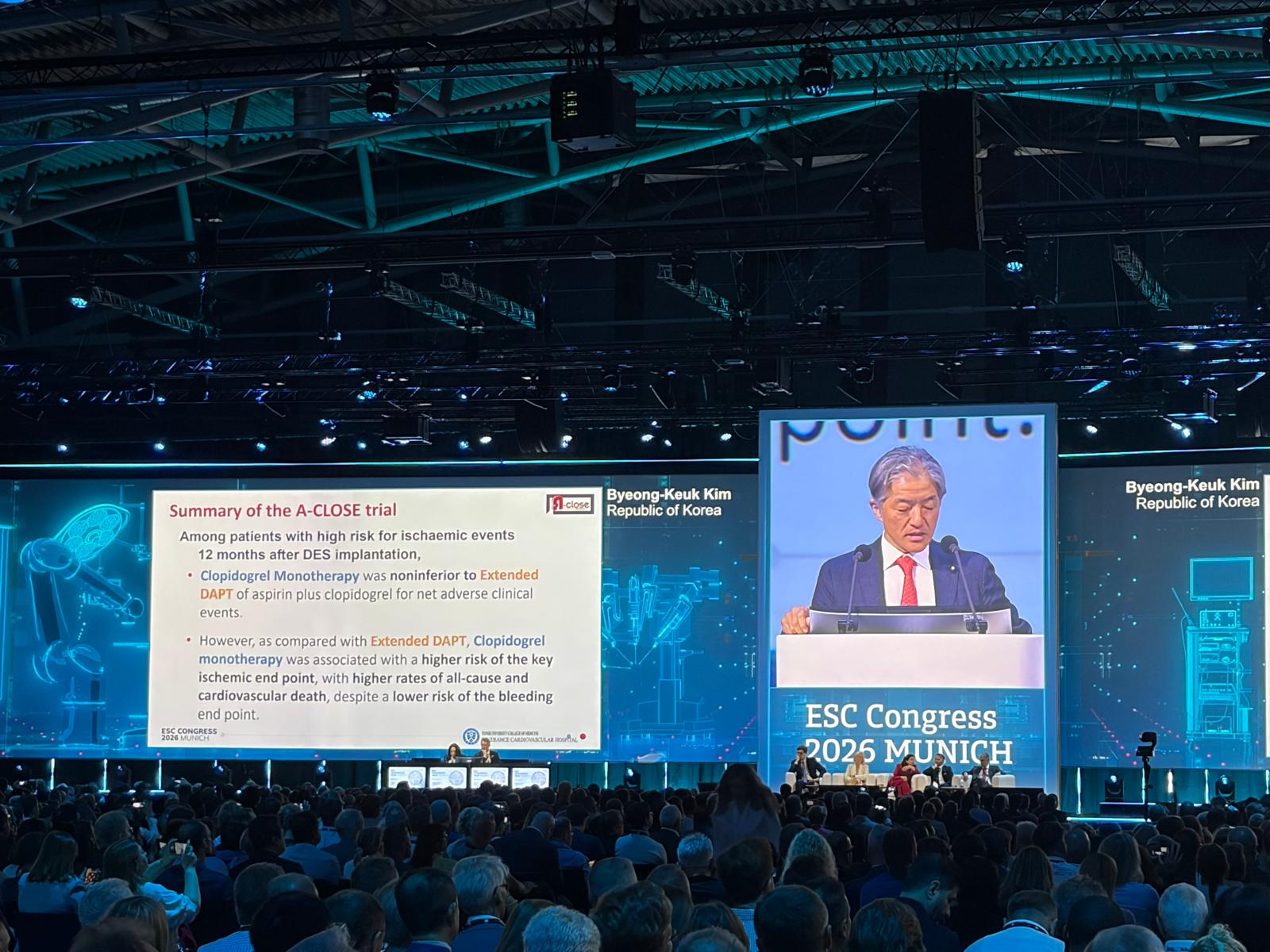
Clopidogrel monotherapy was shown to be non-inferior to extended dual antiplatelet therapy (DAPT) with clopidogrel and aspirin for net adverse clinical events at 24 months among patients at high risk for ischaemic events after implantation of a drug-eluting stent, results of the A-CLOSE trial presented at the European Society of Cardiology (ESC) 2026 congress (28–31 August, Munich, Germany) and published in the New England Journal of Medicine have shown.
Current guidelines recommend six to 12 months of DAPT followed by long-term single antiplatelet therapy with either aspirin or clopidogrel following stent implantation, though some patients remain at high risk for recurrent myocardial infarction (MI) or blood clots. For those at high ischaemic risk, the optimal duration of DAPT beyond 12 months remains uncertain.
“After drug-eluting stent implantation, clinicians must balance protection from ischaemic events against the bleeding risk associated with prolonged DAPT,” A-CLOSE principal investigator, Byeong-Keuk Kim (Severance Cardiovascular Hospital, Yonsei University College of Medicine, Seoul, South Korea) said. “Although clopidogrel monotherapy is increasingly used after DAPT, its efficacy and safety compared directly with extended DAPT has not been tested in patients at high ischaemic risk.”
The A-CLOSE trial compared the two different antiplatelet strategies in high-risk patients who had undergone drug-eluting stent implantation 12 months earlier.
Taking place at 19 centres in South Korea, participants were eligible if they had undergone drug-eluting stent implantation 12 months earlier and had at least one high-risk clinical feature (acute coronary syndrome, diabetes, chronic kidney disease, heart failure, prior stroke or peripheral artery intervention) or high-risk lesion feature (left main coronary artery lesion, a bifurcation lesion, chronic total occlusion, multivessel disease or diffuse long lesions). Participants were randomised to clopidogrel monotherapy or extended DAPT for 24 months.
The study population include 3,203 participants who had a mean age of 63 years and 18.4% were women.
After 24 months, the two strategies produced similar rates of net adverse clinical events. The primary endpoint of all-cause death, myocardial infarction, stent thrombosis, stroke or Bleeding Academic Research Consortium (BARC) type 2, 3 or 5 bleeding with clopidogrel monotherapy was noninferior to extended DAPT (5% vs. 5.1%; p=0.001 for noninferiority).
Of note, a key ischaemic endpoint occurred more frequently with clopidogrel monotherapy than with extended DAPT (all-cause mortality, myocardial infarction, stent thrombosis or stroke: 3.7% vs. 1.6%; p<0.001). All-cause mortality occurred in 1.3% of patients with clopidogrel monotherapy and 0.4% of patients with DAPT.
A key bleeding endpoint occurred less frequently with clopidogrel monotherapy (BARC type 2, 3 or 5 bleeding: 1.8% vs. 4.1%; p<0.001).
Concluding, Kim noted that the results of the A-CLOSE trial showed a clear trade-off in patients at high ischaemic risk.
“Extended DAPT provided greater protection against major ischaemic events, including death, whereas clopidogrel monotherapy reduced major or clinically relevant bleeding,” he said. “It seems that no single strategy is best for every patient, but rather, long-term antiplatelet therapy should be individualised according to ischaemic and bleeding risks, clinical characteristics and treatment preferences in a shared decision-making process between patients and physicians.”