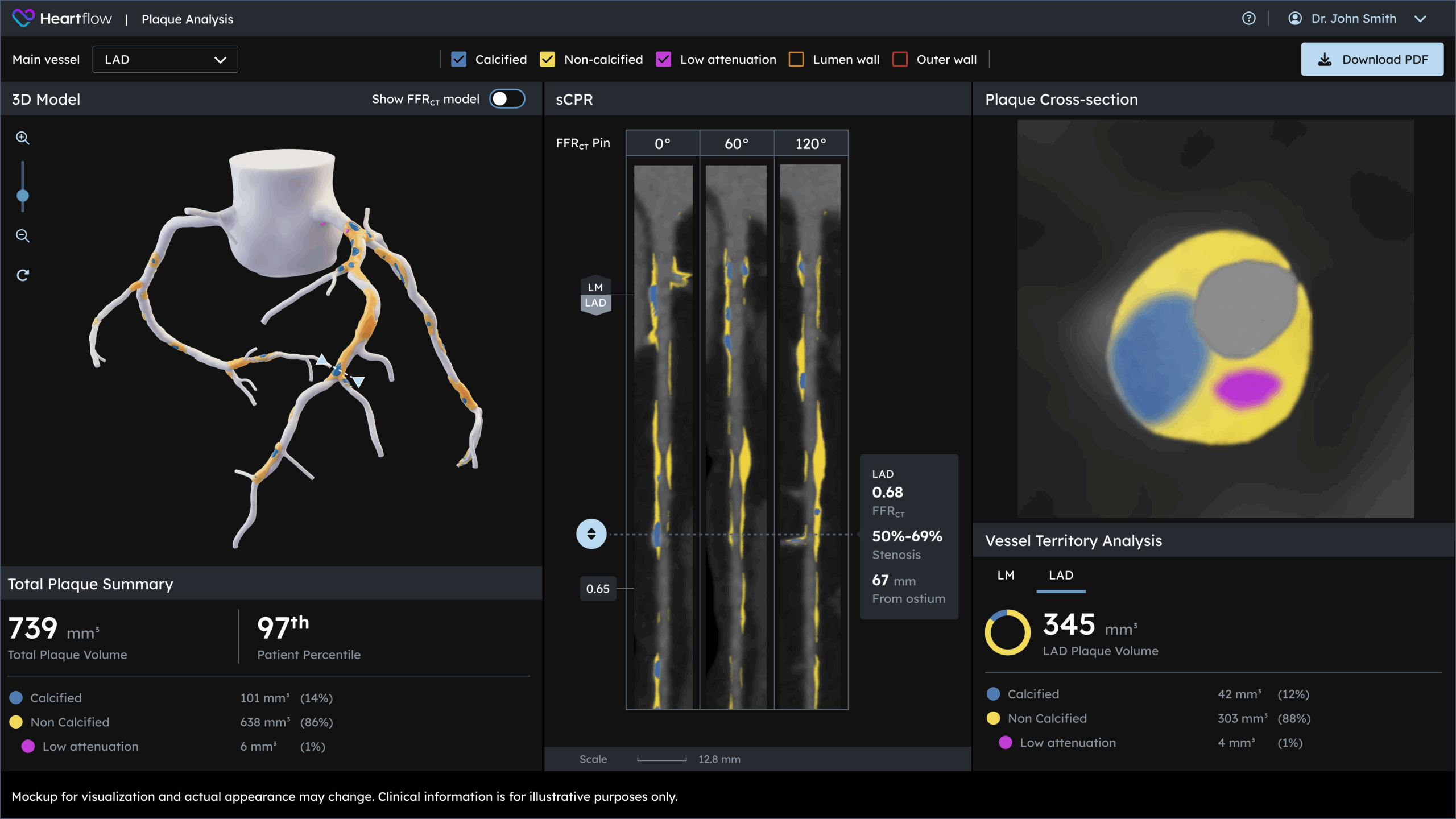
Late-breaking results from the FUSION trial, an investigator-initiated study using computed tomography (CT)-derived fractional flow reserve (FFR)—known as Heartflow FFRct (Heartflow)—for the diagnosis of patients with stable coronary artery disease (CAD), found that use of the artificial intelligence (AI)-derived technology reduced rates invasive coronary angiography by 44% compared to assessment using coronary computed tomography angiography (CCTA) alone.
Enrolling 528 patients with stable chest pain across twelve hospitals in the Netherlands, FUSION is an independent randomised controlled trial funded through the Dutch government’s Zorginstituut Nederland ‘Potentially Promising Care’ programme. The study evaluated Heartflow FFRct Analysis across both academic and community hospital settings, with blinded, independent clinical event adjudication.
Results were presented at the 2026 European Society of Cardiology (ESC) congress (28–31 August, Munich, Germany) and published simultaneously in the Journal of the American College of Cardiology (JACC). At ESC 2026, principal investigator Alexander Hirsch (Erasmus MC, Rotterdam, The Netherlands) commented that though CCTA provides high-resolution anatomical information, this does not include functional information about coronary stenosis, meaning that this may potentially overestimate stenosis severity and lead to referral for angiography in patients who may, in fact, not need it.
“CCTA is established as the optimal first-line diagnostic test for coronary artery disease as it is non-invasive, but when anatomical scans show intermediate stenosis, determining whether that blockage is clinically significant remains a critical challenge,” said Hirsch.
Previous randomised trials, including FORECAST and PRECISE, have evaluated the pathway of CCTA and FFRct in broader patient populations early in the diagnostic pathway, whereas in FUSION FFRct analysis was deployed immediately following a CCTA scan identifying anatomically obstructive stenosis.
One-year results from the study demonstrated a 44% relative reduction in invasive coronary angiography in the FFRct pathway compared to the CCTA-only group (22% vs. 39%; p < 0.001), consistent with the 90-day primary endpoint results (18% vs. 33%; p< 0.001). Overall rates of invasive coronary angiography were significantly lower at one year in the FFRct pathway compared to the CCTA-only group (43% vs. 61%; p<0.001).
Rates of coronary revascularisation remained identical across groups (20% vs. 20%; p= 0.948). There were no significant differences in safety endpoints between pathways, including major adverse cardiac events (MACE), invasive coronary angiography complications, or stroke.
“The FUSION trial shows that adding Heartflow lesion-specific physiology makes CCTA even more powerful and improves diagnostic efficiency. It gives clinicians the clarity to know which patients require further invasive testing, safely avoiding unnecessary invasive catheterisations while maintaining excellent patient outcomes,” said Hirsch.
“One of the persistent challenges in cardiology has been accurately identifying, prior to catheterisation, which patients have disease severe enough to warrant an invasive procedure,” Campbell Rogers, chief medical officer of Heartflow, said in a press release issued by the company highlighting the results. “The FUSION data demonstrate that our technology can meaningfully address this challenge, providing physicians with more precise insight into a patient’s disease burden after CCTA has documented stenosis over 50%. This allows care teams to direct invasive procedures to the patients most likely to benefit, while sparing others the risk and burden of a catheterisation they may not require.”