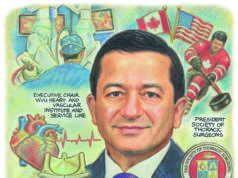
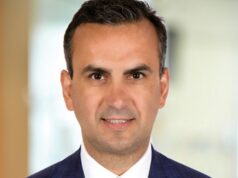
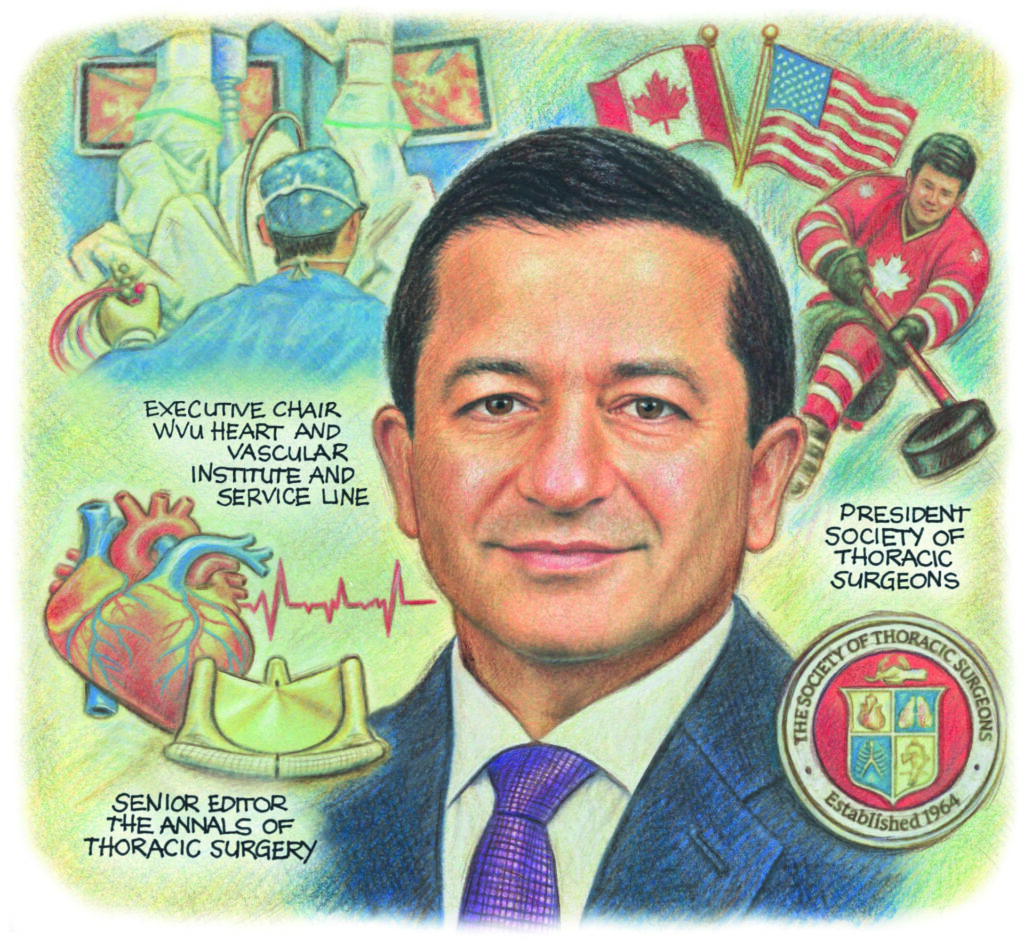
 Society of Thoracic Surgeons (STS) president Vinay Badhwar (Morgantown, USA) talks to Cardiovascular News about his life and career, reflecting on the importance of cross-specialty collaboration in his practice and how it has helped shaped his most recent innovation—the development of the robotic aortic valve replacement (RAVR) procedure.
What brought you to a career in medicine, and to cardiac surgery specifically?
During my early exposure to medicine there were a lot of things I found stimulating. I actually considered pursuing a career in cardiology, but it was the technical precision of surgery, combined with the possibility to immediately improve one’s ability to survive and quality of life through what you can touch, do, and create, that I found the most captivating. With cardiac surgery, the smallest movement of a needle—for example at a distal anastomosis or a valve—can translate to years of life. That is still something that still fascinates me now, more than 30 years later.
Who are the mentors who have shaped your career to date?
I have been blessed to have many mentors. Among them was Wilbert Keon, Canada’s foremost cardiac surgeon at the time, based in Ottawa. One would probably call him old school, but he helped to shape a lot of the things that I’ve done. Even for patients who had been turned down elsewhere he believed that anything was possible and with technical precision and a little dash of courage, we could restore their life. Serving as chief fellow with him completely altered my thoughts on the notion of complexity and the need for precision to generate the best outcome.
What’s been the biggest change in the field since you began practicing?
One big change has been how we have embraced innovation and miniaturisation without sacrificing quality—everything from the development of therapies for structural heart disease all the way to robotics. While there are many great innovations, those that remain sustainable should be safe and translate to excellent long-term outcomes—this is where the challenge now lies. New devices will continue to push through and new evidence helps shape what we do, but we must be sure to remember that we are treating a human being and ensure that we always do what’s best for them, as we would for our own family member. That’s the challenge in today’s world, but it is also the opportunity.
Are cardiac surgery and interventional cardiology complementary or competing specialties?
They’re absolutely complementary. Yes, cardiac surgery is my day job as chairman of the Department of Cardiovascular and Thoracic Surgery at WVU, but I’m also the senior physician executive for our service line which includes cardiology, so I’m an ardent advocate for our cardiologists. What we’ve created here at WVU is, I would humbly say, the essential demonstration of what a true heart team is. We do not compensate by RVUs [relative value units] or productivity—we focus on doing the right thing, for the right patient, at the right time. We work hand in glove every single day to do what’s right at any time; be that from a cardiology perspective or from a cardiac surgery perspective. Part of our duty as leaders in the field is to protect that dynamic, and sometimes that can become challenging when there is an embrace of a certain method or a technique.
I think this is a moment in time where we need to not retreat to silos of care but work across the aisle. We’re really one specialty and we need to protect the heart team, because it’s so valuable. Often outside influences will attempt to fracture the heart team and that’s something that we should all protect against. We’re all better off if we do things together and evaluate the same pool of evidence.
We’re really one specialty and we need to protect the heart team, because it’s so valuable
What has been the main area of focus for your research?
I started out in the basic science world having a lab and doing myocellular biology, but years ago I gravitated to clinical research. My approach to research has been to focus on impact, not just research for research’s sake, but research that could inform clinical decision making, long-term outcomes, and eventually guidelines. This has included contributions in the structural heart space, the treatment of atrial fibrillation, and robotic innovation.
How did your interest in robotics come about?
I’ve been involved in minimally invasive surgery my entire career. I’ve been doing minimally invasive video-assisted procedures through a mini right lateral thoracotomy, largely for mitral repair, since 2002. In 2002, I started using the early version of the robot, but it was frankly not superior to other techniques, so I stayed with endoscopic approaches using shafted instruments. Advances in robotic telemanipulation were introduced in the mid to late 2000s, allowing multiple degrees of freedom of wrist motion. That was game changing, and since 2007 we have never looked back. It was a quantum development that allowed surgeons that already know how to do good cardiac surgery—through a minimally invasive or sternotomy platform—augmentation of multiple different areas and elevated precision.
What will drive greater adoption of robotics in cardiac surgery?
We’re no longer in the infancy, but still in the early phases of adoption, incorporation, and standardisation at scale. We are entering into that next chapter now and robotic technology continues to improve. What I and the STS have concentrated on is how best to standardise training and safe, reproducible adoption. If we keep doing things through a minimally invasive, transaxillary, approach we can make it globally scalable.
How did the robotic aortic valve replacement (RAVR) procedure come about, and what unmet need will this address?
In 2016, we started seeing wider use of minimally invasive therapies to treat aortic valve disease, be that through mini sternotomy, right anterior mini thoracotomy approaches, or of course transcatheter aortic valve implantation (TAVI). There were many options, but there was definitely a need to do something less invasive that would closely replicate the long-standing, excellent outcomes of surgical aortic valve replacement. TAVI is an outstanding therapy when applied to the right person, at the right time, at the right level of risk, but so many patients with aortic valve disease have something else—atrial fibrillation, mitral valve disease or tricuspid valve disease, for example—and you can’t always easily pivot to doing other procedures.
By 2018, we had done multiple cadaveric experiments looking at using the right anterior thoracotomy approach, but after early experiments in the lab, we found it was just too clunky. So, we decided to work on a transaxillary robotic approach, which had not been done before for aortic valve disease. This used the identical platform for robotic mitral surgery. One of the most important elements that accelerated the introduction of RAVR was that it was not just our cardiac surgeons that were interested—so were our cardiologists. My close colleague Ramesh Daggubati, the chief of structural cardiology, and the team here had some disquiet about the embrace of low-risk TAVI in 2019, and they were uncomfortable doing this in a healthy, 70-year-old patient. They wondered whether a robotic approach could be suitable, and together we created the RAVR programme.
Once we’d figured out how to do the technique robotically in the lab environment, we did several cases without the robot, using direct access to make sure that we had all of the safety procedures in place. We reported every case to ensure safety, and once we started doing them robotically in January 2020, it just took off. After that first case, we did the first combined case to treat aortic and mitral disease a month later, and we were able to start incorporating multiple concomitant procedures common in cardiac surgery, septal myectomies and multi-valve procedures, and on and on as we’ve iterated over time. Now we’ve done over 400 cases in our institution and it has become a very routine procedure.
One thing I’m very proud of is that colleagues around the world have embraced it. And there’s probably close to 800 patients being served in multiple countries, across Europe, Asia, and South America. We’ll be reporting an update at the 2027 STS annual meeting (28–31 January, San Diego, USA), but our previous publications have shown that the outcomes are very similar across the world.
How has your membership of the STS contributed to your professional life?
It has been my career honour and privilege to serve the STS, not just as its president, but working with the organisation for over 25 years in all areas, be that health policy, clinical research, data science, and other forms of leadership. What really punctuates the STS is the ability to embrace evidence, as well as the technical aspects, to elevate the field. The quality of individuals that give of their time to align in this mission is awe inspiring. When we work together to generate evidence it can change practice, not just technically, but also in quality outcome reporting and safety.
But it’s not just the STS, all of the professional organisations contribute in a unified manner. I’ve been heavily involved and proud to be involved in collaborating with the European Association for Cardio-Thoracic Surgery (EACTS), the European Society of Thoracic Surgeons (ESTS), the American Association for Thoracic Surgery (AATS), and the Asian Society for Cardiovascular and Thoracic Surgery (ASCTVS) and multiple other international societies in surgery and cardiology.
Upon taking over the STS presidency this year, you pledged to focus on ‘excellence, evidence and impact’. Why these three pillars?
The three pillars of excellence, evidence, and impact truly define what we all are as physicians, but most particularly as cardiothoracic surgeons. Excellence can be described as the pursuit of mastery in terms of technical precision and innovation. Evidence, of course, is obvious—it’s making sure that we do the right thing for the right patient at the right time based on the most up-to-date data, not just for the short term, but also the long term. The combination of both generates impact. That’s the reason we wanted to talk about these three pillars; we don’t just do things for the sake of doing them, it’s not innovation for innovation’s sake, we do it for, most importantly, the long-term impact to our patients and to the specialty as a whole.
What does your life outside of medicine look like?
My wife, Jennifer, is my anchor, and we have two wonderful children, Isabella and Evan. When time permits, we have a cabin we like to go and enjoy. I have Canadian roots and have played hockey all my life, but now I’ve traded in my hockey stick for golf clubs.