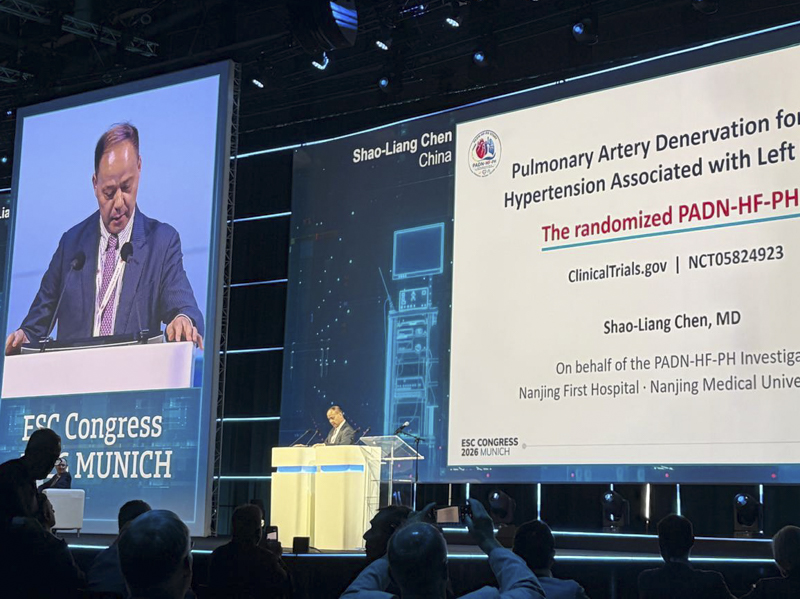
Patients with pulmonary hypertension associated with heart failure were less likely to experience clinical worsening when treated with transcatheter pulmonary artery denervation (PADN) compared to receiving medical therapy alone, the results of a randomised trial conducted at 25 sites in China have shown.
The study—PADN-HF-PH—sought to evaluate the safety and clinical efficacy of adding PADN using the Pulnovo Medical denervation system, which is designed to interrupt the sympathetic nerves innervating the pulmonary arteries, to medical therapy.
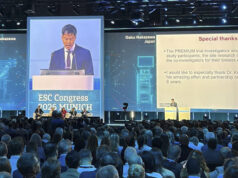
Shao-Liang Chen (Nanjing First Hospital, Nanjing, China) presented findings of the trial during a hotline trial session at the 2026 European Society of Cardiology (ESC) congress (28–31 August, Munich, Germany) with the results published simultaneously in the New England Journal of Medicine (NEJM).
Focusing on a primary endpoint of clinical worsening—a composite of death, heart or lung transplantation, hospitalisation for heart failure, outpatient worsening of heart failure, or a decline in the six-minute walk distance—investigators reported a 51% reduction in the endpoint with PADN compared to medical therapy alone. During a median follow-up of 338 days, the Kaplan-Meier estimated two-year incidence of clinical worsening was 25.7% in the PADN plus medical therapy group, compared to 51.5% in the medical therapy alone group.
PADN was associated with a longer restricted mean time that was free from clinical worsening than medical therapy (19.6 months vs. 16.7 months), for a difference of 87.6 days. Researchers also reported that PADN resulted in improved functional capacity and health status, with patients achieving a net improvement of 24.8 meters in their six-minute walk distance at 12 months.
Additionally, the procedure demonstrated favourable safety, with access-site haematomas occurring in only two patients in the PADN group and in one patient in the medical therapy alone group; there were no other procedural complications.
In the study, a total of 264 patients were randomised, with 134 ultimately undergoing the PADN procedure and receiving medical therapy and 130 receiving medical therapy alone. The study had an open-label design, meaning that patients and physicians were aware of which therapy was administered.
Secondary analysis showed that six deaths occurred in the PADN group, compared to seven in the medical therapy arm but rates of heart failure hospitalisation differed in the two groups, standing at 24.8% in the PADN group vs. 33% in the medial therapy group.
“Several results increase confidence that the observed treatment effects from pulmonary-artery denervation may represent therapeutic benefits,” Chen and colleagues write in their NEJM paper detailing the results. “The reduction in clinical worsening was shown with multiple complementary analytical approaches. The decrease in recurrent heart failure events suggests that pulmonary-artery denervation modifies the overall disease burden rather than simply delaying the first event. The annualised rate of recurrent events was reduced by 35.5%, with treatment of only 3.9 patients required to prevent one heart failure–related event. Concordant improvements in exercise capacity, health status, and ventricular function and structure provide strong internal consistency.”
The authors do, however, acknowledge limitations of their study. No sham control was included and treatments were known to patients and physicians, potentially allowing the possibility of placebo effects and ascertainment bias.
The Pulnovo system is due to be studied further in a US Food and Drug Administration (FDA) investigational device exemption trial—PULSE-LHD—which began enrolling at US sites in August. The study, a multicentre, randomised, placebo-procedure controlled trial, is designed to evaluate the safety and efficacy of the PADN procedure in patients with combined pre- and post-capillary pulmonary hypertension associated with left heart disease (CpcPH-LHD).
These developments come after it was announced in April that Medtronic had made a significant investment in the company, with the option for potential future commercialisation opportunities.