Three months of direct oral anticoagulation (DOAC) therapy was successful in reducing hypoattenuated leaflet thickening (HALT) in patients who had undergone transcatheter aortic valve implantation (TAVI), but the effect diminished nine months after the discontinuation of the therapy.
These are among the findings of the NOTION-4 study evaluating the effect of short-term anticoagulation therapy in preventing subclinical leaflet thrombosis in patients with a recently implanted transcatheter heart valve.
Troels Højsgaard Jørgensen (Copenhagen University Hospital, Rigshospitalet, Copenhagen, Denmark) presented findings of the study during a hot line trial session at the 2026 European Society of Cardiology (ESC) congress (28–31 August, Munich, Germany), with the full results published simultaneously in the Journal of the American College of Cardiology (JACC).
In his presentation, Jørgensen detailed that there is a substantial risk of subclinical leaflet thrombosis—a thin layer of thrombosis forming on one or more of the prosthetic leaflets—after TAVI, which is identified through computed tomography (CT) scans. HALT occurs in 20–30% of TAVI patients within the first year of implant.
“The clinical significance has been much debated,” Jørgensen noted, adding that some studies point towards an association between HALT and thromboembolic events.
Previous studies have shown that HALT can be reduced through the use of anticoagulants, whilst the GALILEO trial has shown that use of a low-dose DOAC may significantly reduce the prevalence of HALT when compared to antiplatelet therapy, albeit with an increased risk of adverse events in TAVI patients with no baseline indication for oral anticoagulant therapy.
NOTION-4 was designed as a prospective multicentre randomised open-label clinical trial to investigate whether three months of DOAC followed by lifelong single antiplatelet therapy (SAPT) would reduce the risk of HALT at 12 months compared to SAPT alone. Eligible patients needed to have had a successful TAVI procedure and no indication for anticoagulant therapy, and were randomised 1:1 to either of the two investigational approaches.
The primary endpoint was the prevalence of HALT at 12 months, as assessed by a cardiac CT scan.
Taking place at two hospitals in Denmark, 352 patients with successful TAVI were included. Following screening, investigators were left with 176 patients in the SAPT group and 171 patients in the DOAC group.
All patients had a CT scan performed at three and12 months. Baseline characteristics were balanced between the two groups, with a mean age of 79 years, a mean Society of Thoracic Surgeons (STS) risk score of 1.8, and most patients were enrolled within one day of their TAVI procedure.
Patients in the SAPT group primarily received acetylsalicylic acid with some receiving clopidogrel, whilst patients in the DOAC group primarily received apixaban with a handful receiving rivaroxaban.
Detailing the primary results, Jørgensen reported that, at 12 months, HALT was present in 32.2% of patients in the SAPT group and 28.3% of patients in the DOAC group, resulting in an absolute risk difference of 3.9 percentage points, without a statistically significant difference between the two groups (p=0.54).
“In contrast, at three months, while patients in the DOAC three month group were still on the active treatment, HALT prevalence was significantly lower, with DOAC treatment at 11.5% versus 31.8% in the SAPT group,” Jørgensen added. “This confirms that DOAC therapy is effective at suppressing HALT while patients are on active treatment.”
Looking at paired CT scans at three and 12 months only in SAPT patients, Jørgensen detailed that the overall HALT prevalence was unchanged at both time points at 32% points.
“In the SAPT group where there were paired CT scans, 58% of patients were without HALT at both time points, 22% of patients had persistent HALT at both time points, and that left 10% either developing or 10% resolving HALT from three to 12 months,” he said.
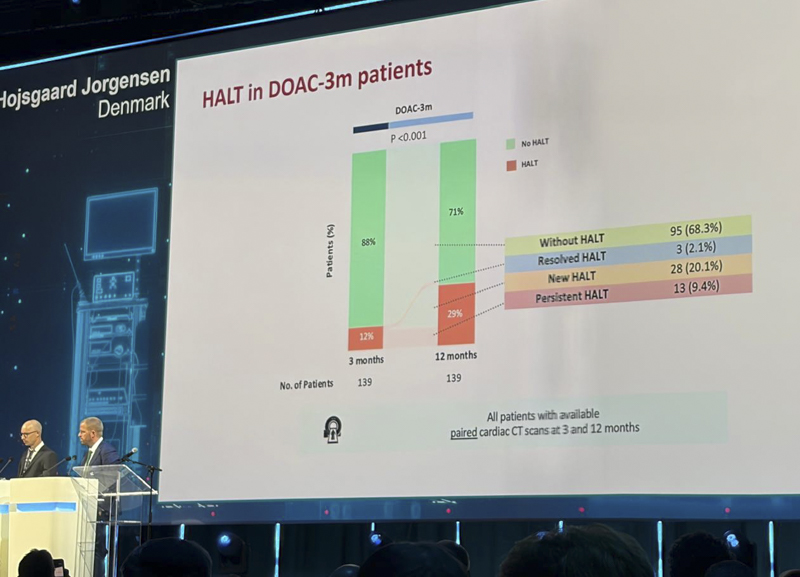
The picture, however, was much different in the DAOC group, where HALT increased significantly from 12% at three months, while the patients were still in active treatment, to 29% at 12 months, nine months after the patients stopped the treatment (p<0.001).
In DOAC patients, 20% developed new onset HALT, while HALT was resolved in only 2% from three to 12 months.
“This indicated that the effect of the DOAC on HALT does not seem durable after the therapy is done,” Jørgensen said.
On safety endpoints, the composite risk of death, thromboembolic events, and major life-threatening bleeding risk was increased in patients in the DOAC group, with a risk of (8.2%) compared to patients only taking SAPT (2.3%).
A three-month landmark analysis found that the excessive risk in the DOAC group mostly occurred during the first three months while they were in active treatment when compared to the SAPT group.
Event rates for the individual components of the safety endpoint were numerically but not statistically significantly higher across the board in the DOAC group.
Jørgensen noted that there are some limitations of the trial, including that the observed prevalence of HALT was higher than anticipated, and the effect of the DOAC was not as durable as hypothesised. Additionally, some patients did not adhere to the assigned treatment strategy.
“The three months of active DOAC therapy significantly reduced HALT, but this effect was diminished nine months after DOAC discontinuation, suggesting that the impact of short-term DOAC on HALT is not permanent,” Jørgensen said in his concluding remarks. “Given the trial’s position, we cannot confirm or exclude a modest sustained effect on HALT in the DOAC group. Importantly, short-term DOAC therapy was associated with an increased risk of clinical events without a corresponding sustained benefit on HALT prevalence in the long term.”
The findings support current guidelines recommending against the routine use of DOAC after TAVI in patients without any other indication for oral anticoagulant therapy, he said.