This advertorial is sponsored by Medtronic

“In the early days of TAVI, our primary focus was on procedural success, ensuring safe valve implantation and minimising periprocedural complications. Today, however, as TAVI expands towards younger patients and those at lower surgical risk, our attention is increasingly shifting towards long-term valve performance and durability,” interventional cardiologist Chiara De Biase (Clinique Pasteur, Toulouse, France) tells Cardiovascular News.
In this context, bioprosthetic valve thrombosis has gained focus in the interventional community as more is understood about the behaviour of bioprosthetic valves into the long term. A meta-analysis published in JACC: Cardiovascular Interventions in 2021, authored by Matthias Bogyi (Medical University of Vienna, Vienna, Austria) and colleagues, found that patients with subclinical leaflet thrombosis had a 2.6-fold higher relative risk of stroke or transient ischaemic attack (TIA) than those without the condition.
According to De Biase, even when a TAVI procedure is technically successful, the transcatheter valve remains exposed to several factors that may affect leaflet integrity and function.
“We should remember that the valve leaflets undergo considerable mechanical stress during crimping, delivery and expansion. Furthermore, their biological surface is fundamentally different from that of native endothelium,” she comments. “Both haemodynamic factors and additional mechanical interventions, such as balloon post-dilatation, may contribute to leaflet stress and potentially influence tissue integrity.”
Thrombus formation on the bioprosthetic leaflets is the main proposed mechanism underlying leaflet thrombosis, De Biase explains, with several factors potentially contributing to this process, including blood stasis within the neo-sinus, altered flow patterns around the prosthesis and incomplete valve expansion. Patient-related prothrombotic factors may also play a role.
Advances in cardiac imaging, particularly multidetector cardiac computed tomography (CT), have improved understanding of the frequency and presentation of leaflet thrombosis following TAVI. CT enables the identification of hypoattenuated leaflet thickening (HALT), which may occur with or without reduced leaflet motion (RLM). According to De Biase, it is important to understand that the detection of HALT does not automatically imply clinically-relevant valve dysfunction, and imaging findings should be interpreted in the context of leaflet motion, haemodynamic performance and the patient’s clinical presentation.
“The fundamental issue is whether subclinical HALT represents simply an imaging finding or a condition with meaningful clinical consequences that deserves specific treatment,” she says. “More specifically, we still need to establish whether HALT translates into worse clinical outcomes, particularly in terms of cerebrovascular events, impaired valve haemodynamic and long-term bioprosthetic durability.”
 Recent three-year results from the SMART trial add a new dimension to this discussion, demonstrating differences in leaflet thrombosis rates between two widely used valve platforms. The SMART randomised trial compared the Evolut (Medtronic) family of supra-annular self-expanding TAVI valves against the balloon-expandable Sapien 3 (Edwards Lifesciences) devices focusing specifically on patients with small aortic annuli, defined as a valve annulus measuring 430mm2 or less.
The continued superior haemodynamic outcomes seen in the trial with Evolut are well known, but the three-year results also highlight that valve thrombosis rates remained significantly higher with Sapien 3 than with Evolut. According to VARC-2 criteria, rates were 5.8% versus 1.3%, respectively (p=0.002). When assessed using VARC-3 criteria, the difference was also significant (6.8% versus 1.3%; p<0.001), with higher rates of both clinical (3.7% versus 0.6%; p=0.0084) and subclinical (3.1% versus 0.7%; p<0.0.023) thrombosis reported with the balloon-expandable platform. Importantly, however, there were no significant differences in aortic valve reintervention.
“I think this is an important observation because it suggests that differences in valve haemodynamics and design may influence the occurrence of leaflet thrombosis,” De Biase comments, albeit cautioning against translating imaging findings into clinical conclusions, with long-term follow-up needed to determine any potential differences in outcomes. “The presence of differences in thrombosis does not necessarily imply differences in clinical outcomes or long-term valve durability.”
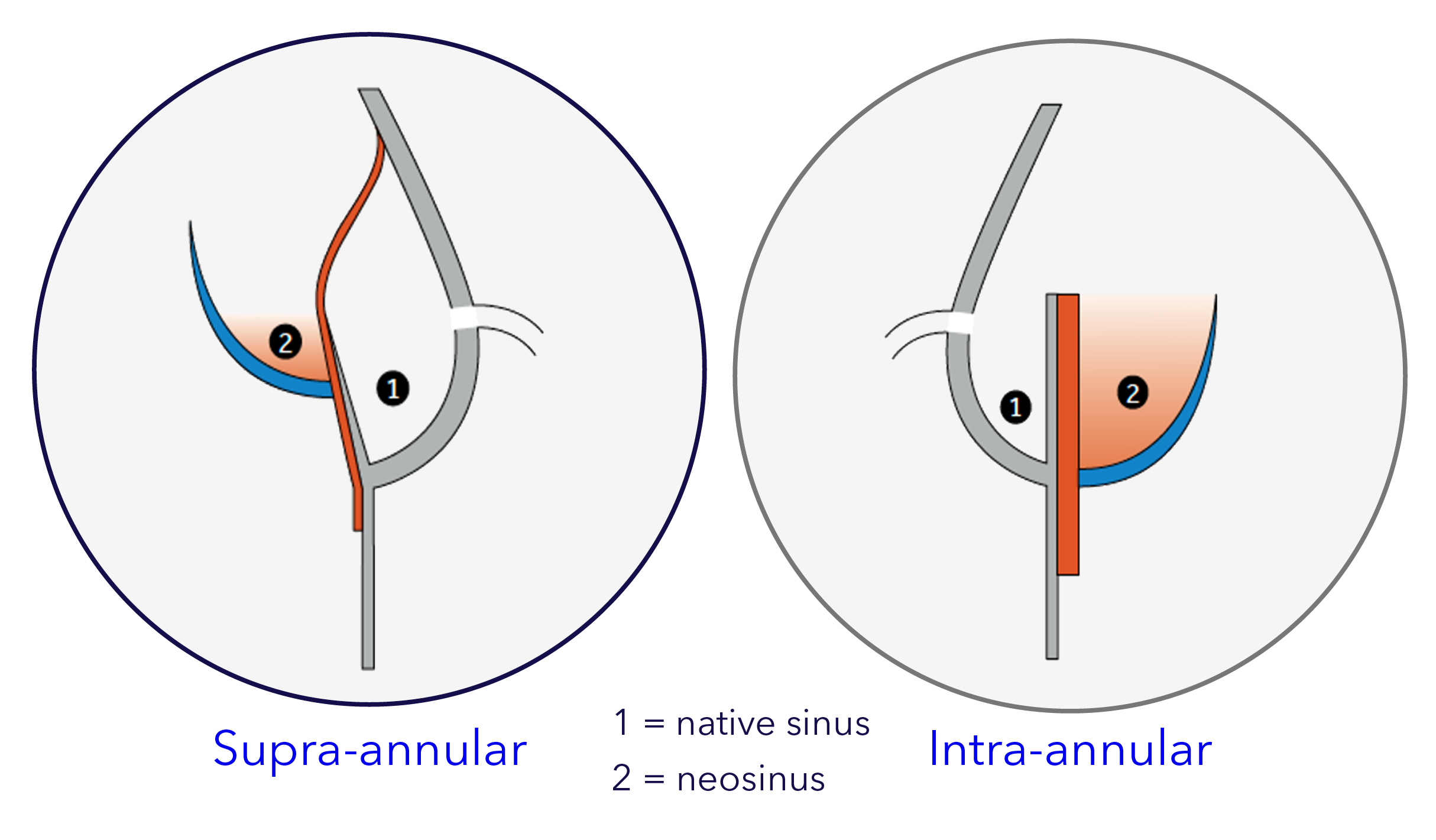
The relationship between valve design and thrombosis remains an interesting area of investigation, De Biase comments, noting that to date several studies have investigated leaflet thrombosis across valve platforms, suggesting that the phenomenon is not restricted to a specific valve design. Supra-annular valves, such as the Evolut series, place the native valve leaflets higher up above the annulus frame, theoretically providing a larger effective opening and lower pressure gradients, likely improving blood flow. In contrast, intra-annular valves keep the leaflets positioned directly inside the native valve space.
“One possible explanation is that the interaction between the transcatheter valve frame and the native annulus may influence leaflet geometry, mechanical stress and local blood flow patterns. In particular, the constraining effect of the native annulus on the implanted prosthesis could potentially contribute to altered haemodynamic and conditions favouring thrombus formation.”
The potential clinical implications of these differences remain uncertain. Although observational evidence has associated subclinical leaflet thrombosis with an increased risk of cerebrovascular events, randomised trials have not established that reducing HALT translates into improved clinical outcomes. The GALILEO trial, for example, demonstrated that rivaroxaban reduced CT-detected leaflet thrombosis, but this did not translate into clinical benefit and was accompanied by increased risks of death and bleeding.
Consequently, De Biase believes that identifying which patients are likely to benefit from anticoagulation remains a key challenge. While oral anticoagulation can resolve HALT, routine treatment of all patients with imaging-detected leaflet thrombosis is not justified, particularly given the potential bleeding risks. The potential impact of recurrent or persistent leaflet thrombosis on long-term valve durability remains an important unanswered question, she adds, noting that this is particularly relevant in the modern TAVI era.
“As we increasingly treat younger patients with longer life expectancy, understanding the potential impact of subclinical leaflet thrombosis on long-term prosthetic valve performance becomes increasingly important,” De Biase states.
For now, the SMART findings highlight a potential difference between valve platforms, but longer follow-up will be needed to determine whether this translates into a meaningful clinical advantage.