New trial data from ALL-RISE and FAST III suggest angiography-derived physiology may simplify decision-making, reduce procedural burden, and help close the gap between guidelines and real-world practice.
Despite robust data and guideline recommendations, adoption of pressure wirebased physiology remains low, with utilisation rates estimated at only 10% to 20% in the USA and Europe. It is against this backdrop that results of the ALL-RISE and FAST III trials, two of the most heralded trials presented at the American College of Cardiology’s (ACC) annual scientific session (28–30 March 2026, New Orleans, USA) and both simultaneously published in the New England Journal of Medicine (NEJM), have cleared the path for a new generation of tools that could enable more rapid, less invasive, and more consistent physiologic assessment within routine coronary angiography. Both technologies tested in these trials—which use slightly different methods to assess coronary blood flow—were shown to be non-inferior to the standard of care.
Studies have demonstrated that adding wire-based tests that directly measure pressure beyond the blockage can more accurately determine how much blood flow is reduced and whether percutaneous coronary intervention (PCI) will benefit the patient, but, this has not led to widespread adoption of these techniques, with added complexity and procedural time to place the wire among the reasons cited as barriers to routine use.
Less invasive methods of assessing the functional relevance of coronary stenosis have been tested, in general using software to model images generated during a coronary angiogram to evaluate whether a coronary stenosis is restricting blood, but to date, large scale trials have yet to yield a convincing alternative. Most notably, the results of the FAVOR III Europe study, published in 2024, failed to demonstrate non-inferiority of quantitative flow ratio (QFR) to wire-based fractional flow reserve (FFR)-guided assessment.
This has prompted renewed interest in alternative angiography-derived approaches that aim to improve the accuracy and robustness of computational physiology, including more recent AI-enabled systems. FFRangio is a frontrunner in this arena, and the system combines AI and advanced computational science to obtain FFRangio values from routine angiograms, eliminating the need for drug stimulation and invasive pressure wires.
“Physiology is best used for intermediate lesion assessment,” Ajay Kirtane (New York-Presbyterian/Columbia University Irving Medical Center, New York, USA), an investigator in the ALL-RISE trial— which assessed the artificial intelligence (AI)-powered FFRangio (CathWorks) system for physiologic guidance during PCI—tells Cardiovascular News, describing how the shift toward simpler, angiography- integrated physiology aligns with a broader effort to define how functional assessment should be applied in routine practice. “It really ought to be a situation where…you take the angiogram and, if the lesions are intermediate, you’re able to get physiology in a quick way and make your treatment decisions.”
Kirtane presented findings of the ALL-RISE study, a prospective randomised controlled trial evaluating the clinical and economic benefits of FFRangio for the diagnosis and treatment of coronary artery disease at ACC.26, where he reported comparable outcomes with the system compared to wire-based FFR assessment.
The trial, which enrolled 1,930 patients in the USA, Israel, Japan, Switzerland and the UK, saw patients randomised to receive either FFRangio or conventional wire-based pressure measurements to guide the decision to perform PCI. The primary endpoint was a composite of death from any cause, a heart attack or any other unplanned procedure to restore blood flow to the heart, at one year. The two approaches showed comparable results, Kirtane reported at ACC 2026, with 6.9% of patients in the FFRangio group experiencing a primary endpoint event, compared with 7.1% in the conventional wire-based assessment group. The computer software-based technique was also faster to perform, and unlike wire-based assessment, did not require additional procedural steps such as the introduction of additional catheters and wires or administration of medication, Kirtane detailed.
“We have shown that using this (FFRangio) software-based tool in the cath lab results in similar clinical outcomes at one year compared with the current gold standard of invasive wire-based assessment,” Kirtane said. “Our hope is that these findings—with a technology that does not require further coronary manipulation beyond a routine angiogram—will lead to increased adoption of coronary physiologic testing as recommended by current guidelines.”
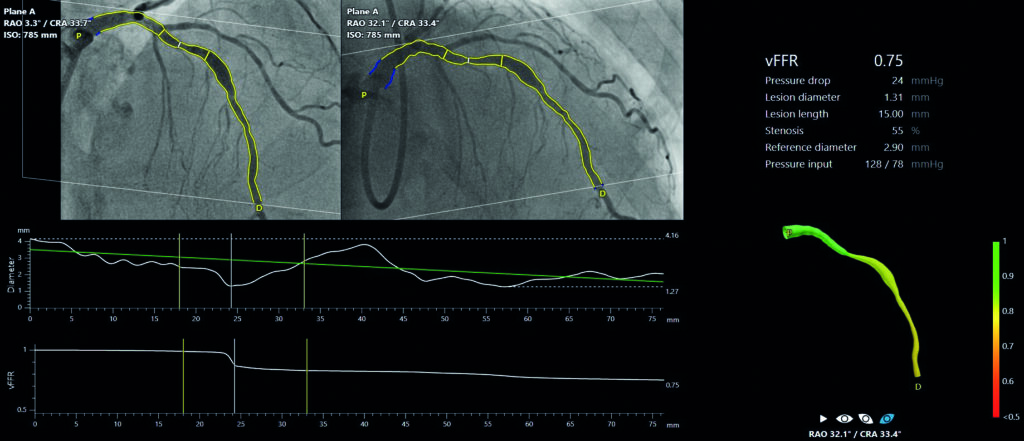
CAAS vFFR (Pie Medical Imaging) represents another image-based computational physiology platform within this emerging class of angiography-derived tools. This is a non-invasive, angiography-based method for calculating FFR values, billed as a faster and easier physiological lesion assessment tool compared to wire-based techniques.
The technology was studied in FAST III, an investigator-initiated, open label, multicentre randomised trial in which investigators assessed the software to FFR-guided coronary revascularisation in 2,235 patients with intermediate coronary lesions (defined as 30–80% stenosis by visual assessment or quantitative coronary angiography). Intermediate lesions were physiologically assessed using tableside vFFR or FFR and treated if vFFR or FFR ≤0.80.
The primary endpoint of the trial was a composite of all-cause death, any myocardial infarction (MI), or any revascularisation at one-year post-randomisation. At ACC.26, Daemen reported that in both groups, 7.5% of patients experienced a primary endpoint event. The key secondary endpoint of study vessel failure occurred in 4% of patients in the vFFR group vs. 4.6% in the conventional FFR group.
“The results of FAST III confirm the safety and feasibility of the online use of vFFR as an easy to use minimally invasive tool to guide revascularisation in patients with intermediate coronary artery lesions in need of physiological lesion assessment,” said Joost Daemen (Erasmus University Medical Center, Rotterdam, Netherlands), who presented the trial’s results at ACC 2026. “The technology has the potential to boost the use of physiology, which may increase the prognosis of patients in whom the decision to revascularise intermediate coronary artery lesions is still largely based on eyeballing. The use of vFFR eliminates the need for guiding catheters, invasive coronary artery instrumentation and hyperaemic agents with inherent risks and patient discomfort.”
A limitation of the study is that it was not blinded, Daemen said—that is, patients and treating physicians knew whether patients had received conventional FFR or vFFR. Another limitation is that only 19% of the patients presented with a heart attack. As a next step, Daemen and his colleagues plan to analyse whether vFFR generates cost savings compared with conventional FFR.
Writing in an accompanying commentary in NEJM, Yiannis Chatzizisis (University of Miami, Miami, USA) says that the trial “provides meaningful support for a less-invasive physiology-guided strategy that may simplify decision making in treating the majority of patients with stable or unstable intermediate coronary lesions”, adding that invasive testing will probably remain necessary in patients with aorto-ostial disease, left main disease, and other complex coronary anatomies.
“More broadly, angiography-derived FFR, together with non-invasive FFR derived from computed tomographic scans, points toward a future in which imaging is no longer descriptive but rather prescriptive, by integrating anatomy, physiology, and biology to guide safer, faster, and more precise and consistent interventions,” Chatzizisis concludes.
The parallel findings from ALL-RISE and FAST III also raise the question of whether these results reflect the performance of individual platforms or signal a broader class effect across angiography- derived physiology technologies.
“The findings of the trial should not be automatically generalised to all angiography-derived FFR platforms, which differ in their methods and performance,” Chatzizisis writes on this point. “In that regard, the results of the ALL-RISE trial of the FFRangio system…are important because they showed that FFRangio was non-inferior to FFR with respect to a composite end point of death, myocardial infarction, or unplanned clinically indicated coronary revascularisation at one year. This finding may help clarify whether the favourable results seen with one platform that was used to calculate the FFR from angiographic images reflect a broader class effect or remain platform-specific.”
Reflecting on whether the results of the two trials, taken together, will herald a shift away from wire-based physiology, Kirtane tells Cardiovascular News that both wire- and angiography-based physiology tools will have a role to play, but says that having simpler-to-use options could potentially open the door to greater use of physiology in the cath lab overall. “I don’t view these as competitive, I just view one, perhaps as easier to use,” he comments. “I don’t think the wire is going to go away, I view these as on a continuum; but, I do think that because of the ease of use of angiography- based systems, as long as the angiogram is good, it will probably supplant wire-based physiology in a lot of cases where previously some operators only felt that the wire was an option.”
Also writing in NEJM, Gianluca Campo (Azienda Ospedaliero Universitaria di Ferrara, Cona, Italy) concurs that the results do not herald the end of pressure-wire measurement, but should enable greater use of physiologic assessment in the cath lab. “As the evidence evolves, the goal is a catheterisation laboratory in which revascularisation decisions are guided by physiological findings across clinical settings, measured invasively with a pressure wire or derived from angiography,” Campo states. “The ALL-RISE trial does not serve to displace the pressure wire; rather, it underscores a broader shift toward physiological assessment as the principal framework for interpreting coronary disease and guiding appropriate PCI.”
The findings from ALL-RISE and FAST III signal a potential inflection point for coronary physiology— by reducing procedural complexity and integrating functional assessment more seamlessly into routine angiography, angiography-derived platforms may help close the gap between guideline recommendations and real-world practice.
Industry moves also seem to reflect this new reality, with Medtronic’s acquisition of Cath- Works, developer of the FFRangio system, completed subsequent to the release of the ALL-RISE trial results at ACC 2026, further underscoring the growing confidence in this space. While questions will remain around optimal implementation and patient selection, the trajectory is clear: physiology is becoming more accessible, more automated, and more deeply embedded in everyday decision-making in the cath lab.