New data suggest that interventionalists can safely opt to defer the treatment of non-culprit lesions when addressing ST-segment elevation myocardial infarction (STEMI) and multivessel coronary artery disease.
This is the finding at three years of a trial of two revascularisation strategies for STEMI in patients with multivessel disease, in which instantaneous wave-free ratio (iFR)-guided revascularisation was shown not to be superior to staged treatment guided by cardiac magnetic resonance imaging (CMR) against outcomes including death, recurrent myocardial infarction (MI), or hospitalisation for heart failure.
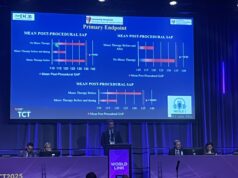
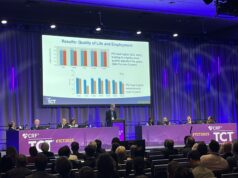
Robin Nijveldt (Radboud University Medical Center, Nijmegen, the Netherlands) presented the three-year findings of the iMODERN trial at the 2025 TransCatheter Therapeutics (TCT) conference (25–28 October, San Francisco, USA), and the data were simultaneously published in the New England Journal of Medicine.
The trial enrolled 1,146 patients across 41 hospitals in 14 countries, who were randomly assigned to either immediate physiology-guided treatment guided by iFR, a non-invasive diagnostic tool, or staged treatment guided by CMR, carried out within four days to six weeks after the initial episode.
At the three-year timepoint, the trial found no significant difference in major outcomes between the two approaches against the combined endpoint of death, repeat MI, or hospitalisation for heart failure.
Nijveldt tells Cardiovascular News that the trial’s results should cement deferred, complete revascularisation as an option for cath lab teams when treating multivessel STEMI patients, running counter to guidelines which recommend immediate revascularisation in the setting of STEMI and multivessel disease.
“If you have an acute event during the day, stenting the culprit lesion, and you have an additional stenosis, with your team around you and a little bit of time, then you can easily do additional stenting of the non-culprit lesion—then the patient is fully revascularised and everything set,” Nijveldt comments. “On the other hand, if you are in the middle of the night or some other acute event comes up, you also know that you can defer, and with a stress CMR scan you can pick a significant lesion up as well at a later timepoint.”
Nijveldt adds the population of patients seen in the trial will be familiar to cath lab teams, with as many as half of patients with STEMI presenting with multivessel disease. Several trials have demonstrated benefits of complete revascularisation for treating multivessel disease, however whether to treat non-culprit lesions immediately or perform a staged PCI remains a point of contention, he said, though many interventionalists are reluctant to address multivessel disease without first waiting for symptoms.
“Should you do it directly during the initial event, or can you also wait? There are a few trials that tried to see whether that was non-inferior during the initial phase compared to waiting,” he detailed. “In that way, our trial is different to others. We used a pragmatic approach, where we said that if you have to wait, you can do it non-invasively.”
“These results show us that the direct assessment of stenting with iFR is not superior to waiting and doing cardiac MRI stress perfusion scans,” he said. “I think it gives the physician a little bit more of an option to know what to do. We already know that doing nothing is not the right way to do it, so now you have more methods to treat the patient the right way.”