Royal Philips has introduced DeviceGuide, an artificial intelligence (AI)-powered device tracking solution to provide real-time visual guidance to support mitral transcatheter edge-to-edge repair (TEER) procedures. The innovation was previewed for the first time at PCR London Valves 2025 (16–18 November, London, UK).
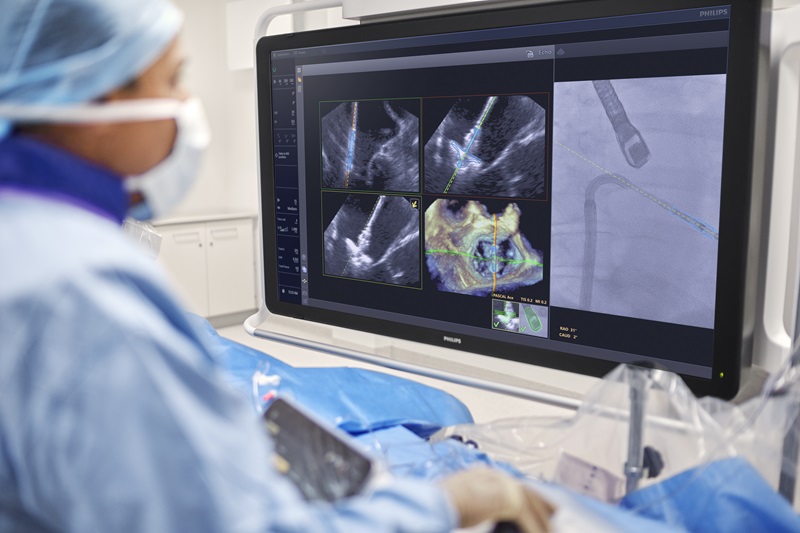
The system is built on Philips’ EchoNavigator platform and uses an AI algorithm to automatically track a mitral TEER device as it moves through the heart, combining live echo and X-ray images to create a virtual 3D model of the device in real time. This 3D model is superimposed on live images of the beating heart to aid implantation.
“With DeviceGuide, we’re bringing AI into the heart of the procedure room, and into the heart itself,” said Atul Gupta, chief medical officer, Diagnosis & Treatment at Philips. “This is Philips’ first AI assisting physicians in real time to visualise and guide heart valve treatment devices as they navigate the beating heart. It’s helping doctors in the moment as they are helping their patients with structural heart disease.”
The innovation was developed in collaboration with Edwards Lifesciences, developer of the Pascal mitral TEER system. Philips says that DeviceGuide can help to shorten the learning curve and create consistent visual guidance for mitral TEER procedures.
“The AI software serves as an assistive tool, with the physician always remaining in control. This isn’t about replacing expertise—it’s about amplifying it,” adds Gupta. “By embedding AI into the procedure, DeviceGuide gives physicians an extra pair of eyes, effectively bionic vision, helping them treat more patients safely and confidently.”
“DeviceGuide demonstrates the impact of combining leading imaging and therapy expertise to develop solutions designed around the procedural workflow, a model that will shape the future of AI-enabled image-guided structural interventions,” said Mark Stoffels, business leader, Image Guided Therapy Systems at Philips.