An artificial intelligence (AI)-powered tool for physiologic assessment during percutaneous coronary intervention (PCI)—FFRangio (CathWorks)—performed similarly to the standard, more invasive wire-based procedure, results of the ALL-RISE trial presented at the American College of Cardiology’s annual scientific session (ACC.26; 28–30 March, New Orleans, USA) have demonstrated.
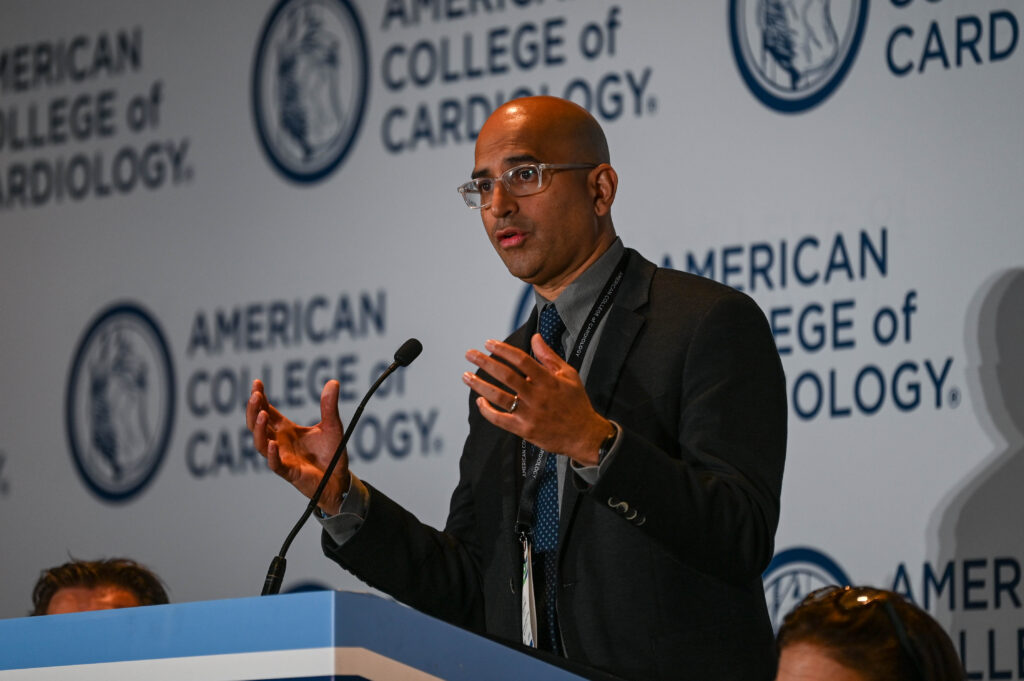
Ajay J Kirtane (New York-Presbyterian/Columbia University Irving Medical Center, New York, USA), presented the one-year clinical outcomes of the trial, which were simultaneously published in the New England Journal of Medicine, during a late-breaking trials session at ACC.26, showing that FFRangio met non-inferiority to invasive pressure wire guidance in terms of major adverse cardiac events (MACE), with improved resource utilisation and reduced procedure time benefits.
“We have shown that using this (FFRangio) software-based tool in the cath lab results in similar clinical outcomes at one year compared with the current gold standard of invasive wire-based assessment,” Kirtane said. “Our hope is that these findings—with a technology that does not require further coronary manipulation beyond a routine angiogram—will lead to increased adoption of coronary physiologic testing as recommended by current guidelines.”
The ALL-RISE trial included 1930 patients enrolled across 59 global sites in North America, Asia, Europe and the Middle East. Patients presenting with coronary stenoses of intermediate significance were randomised to physiological assessment with CathWorks (FFRangio group; 965 patients) or an invasive pressure wire-based approach (pressure wire group; 965 patients).
Participating sites could choose whether the patients randomised to the pressure wire group were assessed with fractional flow reserve (FFR), requiring drug stimulation, or non-hyperaemic pressure ratio (NHPR) tools. Notably, this was the first-ever randomised controlled trial in the USA to assess clinical outcomes of a US Food and Drug Administration (FDA)-approved angiography-derived physiology (ADP) solution for physiologic lesion assessment and the first-ever to compare an ADP technology to either FFR or NHPR.
The primary endpoint of the ALL-RISE trial was a composite of death, myocardial infarction or unplanned, clinically indicated revascularisation at one year. At one year, the primary endpoint event rate was 6.9% for the FFRangio group and 7.1% for the pressure wire group (hazard ratio [HR] 0.98; 95% confidence interval [CI] 0.70 to 1.39) with a non-inferiority p-value of 0.0008.
Both the FFRangio group and the pressure wire group showed a similar safety profile with no apparent differences with respect to the incidence of bleeding, acute kidney injury or procedure-related adverse events.
The FFRangio group demonstrated improved resource utilisation in the catheterisation lab with reduced radiation exposure and less use of contrast medium than the pressure wire group. Despite having a slightly higher rate of percutaneous coronary intervention, the FFRangio group demonstrated a shorter assessment time to perform the physiology analysis as well as a shorter overall procedure duration.
In a joint statement, the executive study chair, Martin B Leon (New York-Presbyterian/Columbia University Irving Medical Center, New York), Kirtane, the study’s chair and global principal investigator, Kirtane, and co-principal investigators, William Fearon (Stanford University, Stanford, USA) and Allen Jeremias (St Francis Hospital & Heart Center, Flower Hill, USA), stated: “Progress in cardiovascular disease is driven by strong partnership, relentless discovery and clinical rigour that challenges existing practices. The ALL-RISE trial is a landmark, randomised controlled trial assessing how artificial intelligence and advanced computational science can obtain physiologic information once only obtained by an invasive procedure.
“The compelling results of the ALL-RISE trial demonstrating CathWorks FFRangio had similar clinical outcomes to the current reference standard should serve as the impetus to increase adoption of physiology worldwide. With significant workflow advantages and a suite of intraprocedural tools that help optimise clinical decision making, CathWorks FFRangio can help advance cardiovascular care for clinicians and patients.”