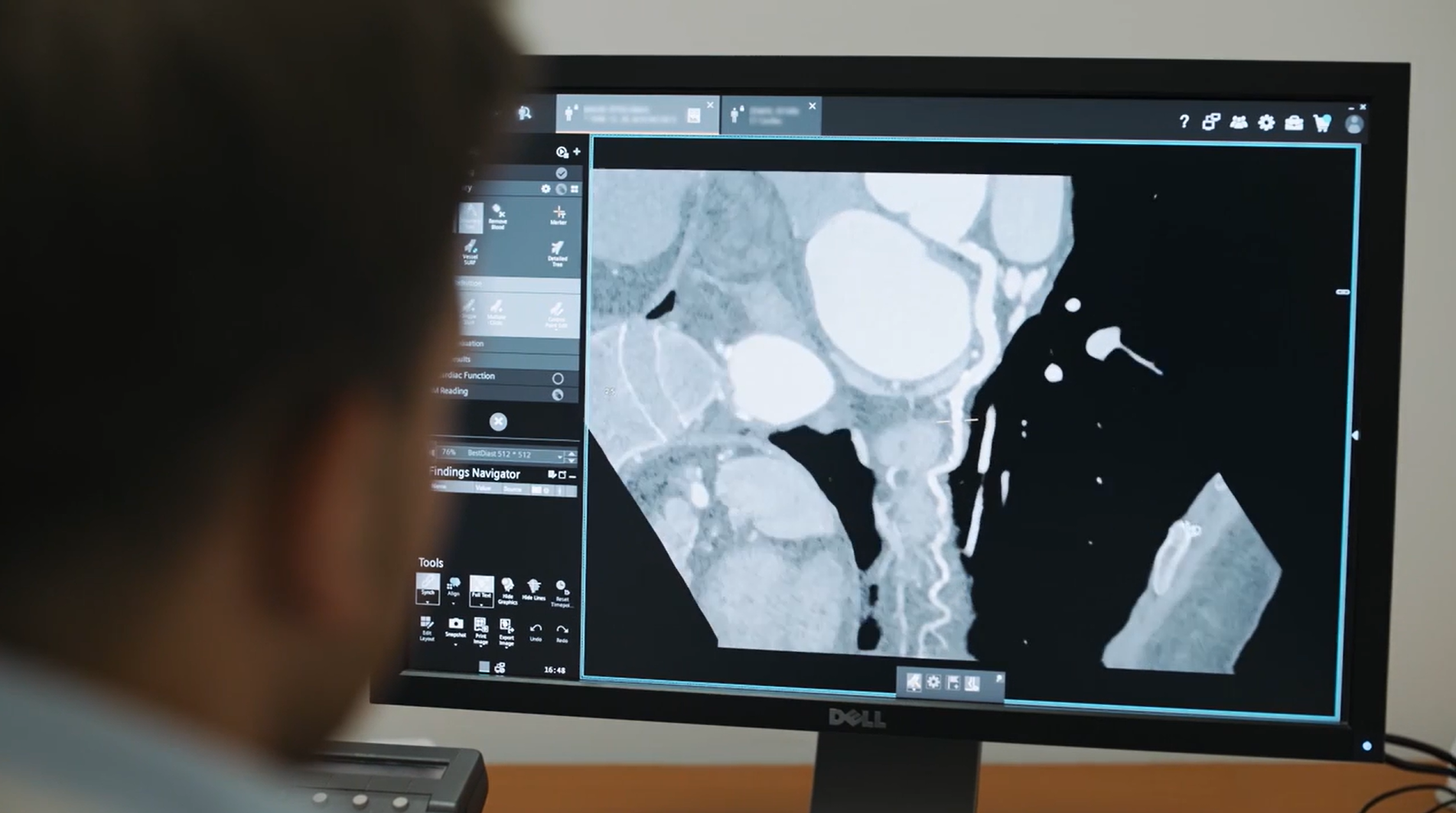
 Siemens Healthineers has announced a new software solution within its Syngo.via imaging platform designed to support the management of coronary artery disease (CAD) for both dual-source and photon-counting computed tomography (CT) scanners—Syngo.CT Coronary Cockpit.
The new tool provides advanced, automated plaque analysis, a press release from the company states, supporting clinical decision-making and intervention planning.
“There is a lot of information that is locked within CT images. Syngo.CT Coronary Cockpit is an automated tool that provides a fast approach to unlock this information to include it in our everyday clinical routine,” Balint Szilveszter (Semmelweis University, Budapest, Hungary) commented. “The information can be used for optimising medical therapy or to plan PCI [percutaneous coronary intervention] procedures before even entering the cath lab.”
To enhance diagnostic confidence, Syngo.CT Coronary Cockpit characterises both the amount and the morphology of coronary plaque through artificial intelligence (AI)-based segmentation, labelling, and visualisation.
Information such as plaque composition, size, and distribution supports clinicians in better assessing risk and selecting the most appropriate treatment, whether medical management or intervention, the company says in its press release.
“With Syngo.CT Coronary Cockpit, we combine our expertise in CT imaging and interventional therapy to help people with coronary artery disease live longer, healthier lives,” said Philipp Fischer, head of Computed Tomography at Siemens Healthineers. “This joint approach paves the way for a future where CT not only diagnoses but actively guides treatment decisions. It marks an important step toward CT-guided PCI and brings us closer to personalised, minimally invasive care.”
Siemens Healthineers announced the launch to coincide with the Radiological Society of North America (RSNA) 2026 annual meeting (30 November–4 December, Chicago, USA), where it also unveiled Optiq AI, an artificial intelligence (AI)-powered imaging system that is designed to deliver high-quality low-dose images for image-guided procedures.