Playing music to patients undergoing percutaneous coronary intervention (PCI) may reduce stress and pain while enhancing the overall patient experience, the findings of a pilot randomised trial have demonstrated.
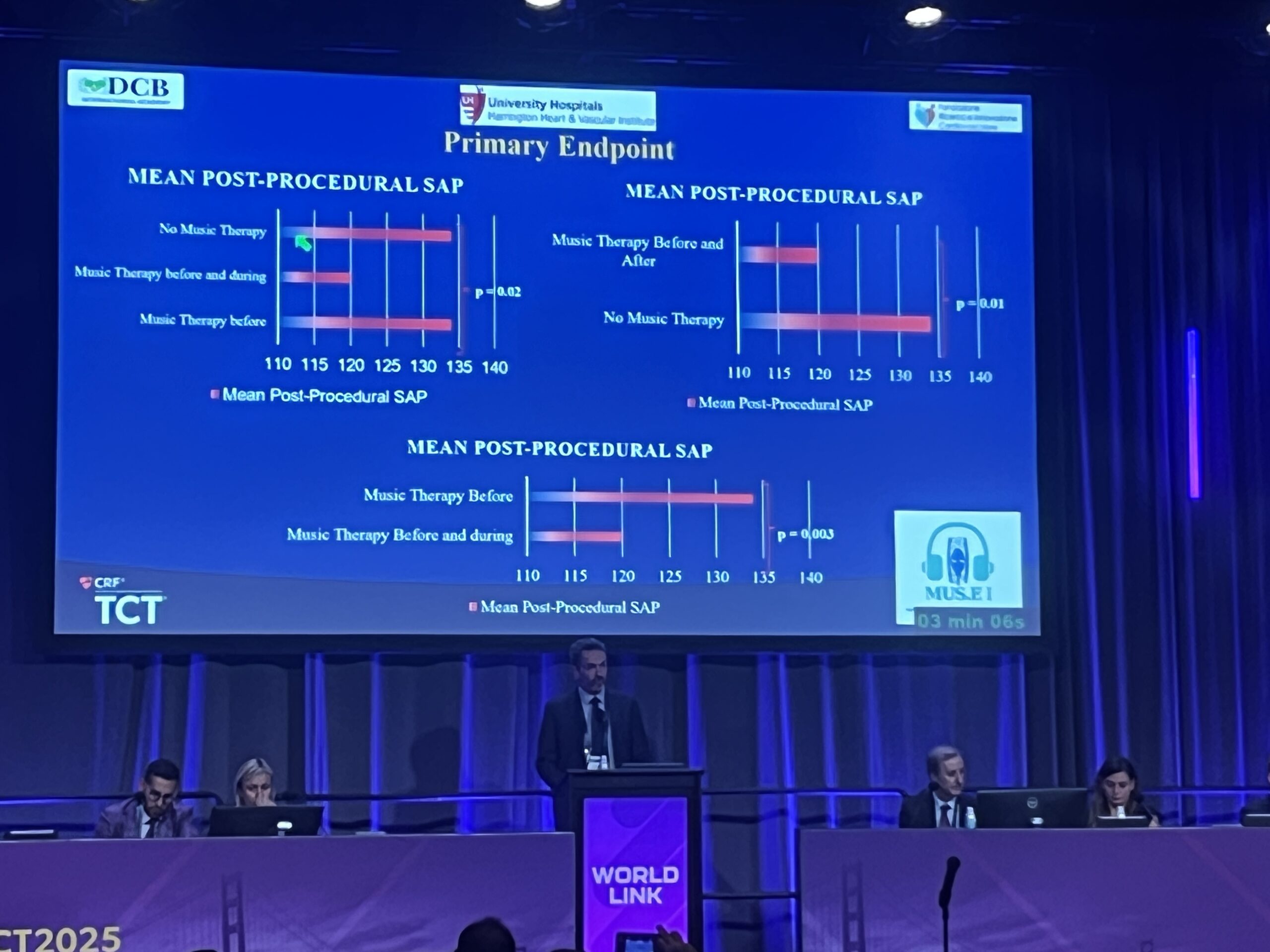
Bernardo Cortese (Harrington Heart & Vascular Institute UH, Cleveland, USA) presented findings of the trial—MUS.E I— at the 2025 Transcatheter Cardiovascular Therapeutics (TCT) meeting (25–28 October, San Francisco, USA), where he reported that patients who listened to music before and during their PCI experienced significant reductions in postprocedural systolic blood pressure, along with improvements in pain, heart rate, and troponin, compared with patients who received no music during the procedure.
“Not only do patients love it,” Cortese told Cardiovascular News, “nurses love it as well.”
This study sponsored by Fondazione Ricerca e Innovazione Cardiovascolare (RIC), involved 100 patients (mean age 67 years; 81% male) undergoing PCI procedures at Grand Hôpital de l’Est Francilien (Paris, France). The study used a music therapist from Fondazione RIC, Beatrice Barbano, who, based upon the findings of a series of questionnaires given to the patients, produced a tailored playlist for each participant, mainly comprising opera, jazz, pop and classical music.
“We know that high anxiety has, in previous studies, been associated with a poorer outcome,” said Cortese, who explained that the study team’s theory had been that music therapy would be an easy, safe, and affordable route to reducing haemodynamic and biomechanical stress for their patients.
The study team, led by primary investigator Rima Chaddad (Grand Hôpital de l’Est Francilien, Paris, France), randomised patients into three groups: one group had music played before and during the procedure, one played before only, and one group received standard care with no music. They used systolic blood pressure as a surrogate for stress as the study’s primary endpoint, with other cardiovascular parameters, including diastolic blood pressure, heart rate, B-type natriuretic peptide (BNP) level, and troponin, included as secondary endpoints.
“Music therapy played before and during PCI significantly reduced systolic blood pressure at the end of the procedure, whereas no music therapy and music therapy only before PCI didn’t have any effect on systolic blood pressure,” said Cortese of the trial’s primary endpoint result in his presentation at TCT 2025.
The level of pain reported by the patients immediately post-procedure was also higher in the group who had no music played at all, despite these patients receiving higher levels of sedation.
Cortese noted that the results merit further investigation, and this has prompted the initiation of MUS.E II, a second randomised trial which will assign patients either to moderate sedation or music therapy before and after the procedure, using a dedicated app to guide the intervention, monitor physiological responses in real time, and systematically collect patient data throughout the procedure, ensuring a precise and personalised approach.
“The findings of the MUS.E I randomised controlled trial support tailored music therapy as a safe, affordable, and effective non-pharmacological intervention to reduce cardiovascular stress, ease pain, and enhance the overall patient experience during percutaneous coronary intervention,” Cortese commented. “The MUS.E II randomised clinical trial will delve into more details about the effect of music on troponin, cortisol reduction, and the possible reduced need for opioids and anxiolytics in the Cath lab.”
“We know that music modulates the autonomic nervous system; we know that music increases parasympathetic tone and dampens cortisol and catecholamine release, so in other words, it helps patients’ hearts literally and figuratively find a better, more pleasant rhythm,” Maciej Lesiak (Poznan University of Medical Sciences, Poznan, Poland) said of the findings at TCT. “While we doctors are concentrating and focusing on optimising stent implantation, imaging guidance, etc, this is just a parallel great innovation, and this is very important. It requires no cost, no training, and starts with just a playlist.”