Latest clinical data for the Dragonfly transcatheter mitral valve repair (TMVR) system (Valgen Medtech) were shared at PCR London Valves (16–18 November, London, UK)—one of several new-entrant transcatheter valve systems highlighted at the meeting—with the performance of the device having been described as comparable to those for existing, commercially-available platforms.
In a late-breaking trial presentation, Francesco Maisano (IRCCS Ospedale San Raffaele, Milan, Italy) shared three-year results from the Dragonfly-DMR China pivotal study, assessing the use of the device for the treatment of symptomatic chronic degenerative mitral regurgitation (DMR) at 27 sites in China, alongside six-month results of the Dragonfly EU pivotal study, ongoing at eight European centres.
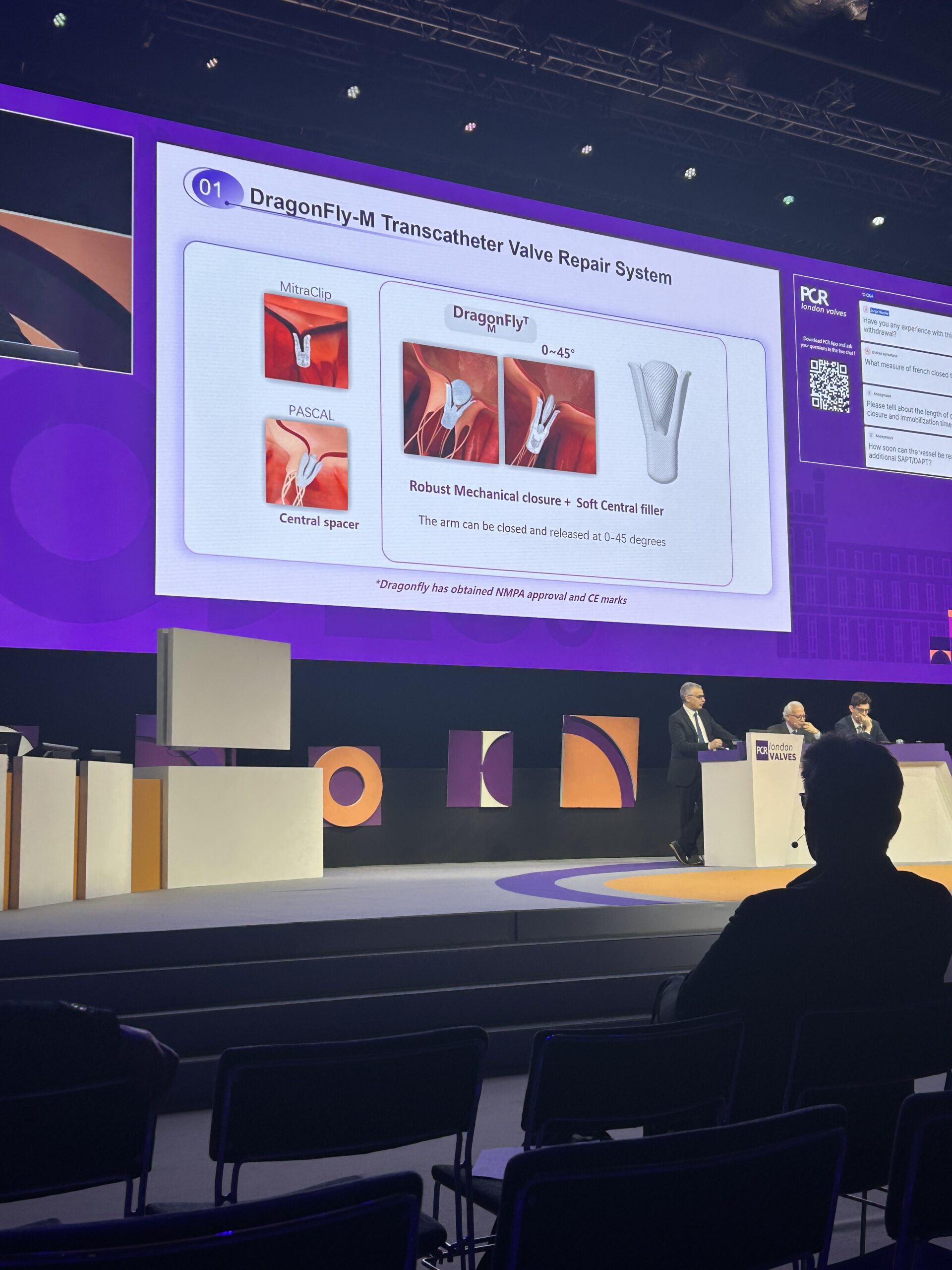
The device, which can be deployed for transcatheter edge-to-edge repair (TEER) in the mitral or tricuspid valves, has similar design features to existing mitral TEER devices including MitraClip (Abbott) and Pascal (Edwards Lifesciences), and includes a mechanical closure system and central spacer. The device has received approval from China’s National Medical Products Administration (NMPA) and CE mark to date.
A total of 120 patients were enrolled in the Chinese pivotal study of the device, with follow-up available in 108 patients at three years, Maisano reported. The trial’s primary endpoint was a composite of avoidance of death, mitral valve reintervention or recurrence of mitral regurgitation (MR) at 12 months, with patients eligible for inclusion if they met high surgical risk criteria. Patients had an average age of 75 years, with the procedures taking an average of 116 minutes, including a device time of 96 minutes, and typically involving around 1.5 clips per patient.
Maisano detailed that at 36 months, 82.5% of patients met the primary efficacy endpoint, 92% had better than moderate to severe MR, and sustained improvements in New York Heart Association (NYHA) class were seen, with 88.5% of patients in NYHA class I-II at three years.
Single-leaflet device attachment (SLDA)—where one leaflet becomes detached from the clip—occurred in one patient at 12 months and one further patient at 36 months, whilst no device embolization was seen up to the three-year timepoint.
Turning to the results of the device in the European patient cohort, Maisano detailed that a total of 39 patients received the Dragonfly system at the eight European sites. Patients were slightly older (with an average of 80 years) compared to the Chinese trial, and the baseline surgical risk was typically lower.
Additionally, most of the sites participating in the European trial were high-volume TEER centres, which was reflected in a significantly lower procedure (53.6 minutes) and
device (41.7 minutes) time compared to the experience in Chinese centres. “This is an almost 50% reduction compared to what has been observed in China, which represents not a learning curve specific to the device, but I think is a learning curve which has been already managed in centres in Europe,” Maisano commented.
MR reduction to ≤2+ was seen in 93% of patients at six months, with 96.7% of patients in NYHA class I-II at this timepoint.
“Dragonfly incorporates several unique design features, taking some good features from different devices,” said Maisano of the performance of the device in his closing remarks. “The clinical values have been demonstrated in both Chinese up to three years and the European populations, and the device is at the moment CE marked, but still in the early stages of commercialisation.”
Following his presentation, Maisano was asked if he thought there were distinguishing factors that would lead clinicians to choose the Dragonfly system over existing platforms including MitraClip or Pascal. “It’s very much operator dependent,” he commented. “In my opinion, the winning proposition of these devices will be the reliability of the system, in terms of how the delivery system reliably transfers the movements that the operator is acting on it, as well as the way the device itself behaves properly in terms of closure and durability and leaflet insertion.”