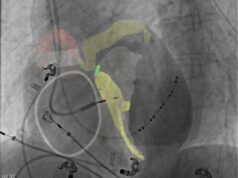
 CorWave has announced the first-in-human implantation of its left ventricular assist system (LVAS) based on breakthrough wave membrane technology, performed by the team at St Vincent’s Hospital in Sydney, Australia.
Inspired by the swimming motion of aquatic animals, CorWave’s undulating membrane technology, developed since 2012, aims to preserve the physiological balance of the cardiovascular system, unlike currently used rotary pumps that deliver a continuous and fixed flow rate. The device has been designed to preserve the effects of the heartbeats on the vasculature and work in synchrony with the heart to preserve its function and structures. It can also automatically adjust blood flow according to the patient’s activity, whether at rest or in motion.
According to CorWave, the innovation has three clinical objectives: to limit serious complications associated with current devices, such as strokes, bleeding, heart failure, or valvular diseases, to improve patients’ quality of life with a broader resumption of daily, professional, and social activities and to promote heart recovery.
This first patient successfully met the primary endpoint of 30-day survival without device-related complications. Suffering from advanced heart failure, he is doing well and has been discharged from the hospital, CorWave said in a press release.
Louis de Lillers, chief executive officer of CorWave, said: “This world first is a success and results from more than a decade of determined research and engineering. We owe this moment to the trust of the patient, the excellence of the team at St Vincent’s, the perseverance of our team, investors and partners who have backed CorWave’s vision over the years. We look forward to writing a new chapter in circulatory support alongside the scientific and medical community, with the shared goal of significantly improving the lives of advanced heart failure patients.”
Christopher Hayward, a cardiologist specialising in heart failure and heart transplantation at St Vincent’s Hospital and principal investigator of the study, said: “The entire medical team is impressed by the CorWave device’s performance. We’re very happy with the patient’s post-operative recovery. The results we’re seeing are very encouraging for the future.”
Paul Jansz, cardiothoracic surgeon, adds: “The surgical procedure is very similar to the implantation of the current generation of left ventricular assist devices. However, unlike the latter, this new generation system allows for the preservation of the natural pulse, which is potentially a game-changer. We could be opening up a new era of circulatory support.”