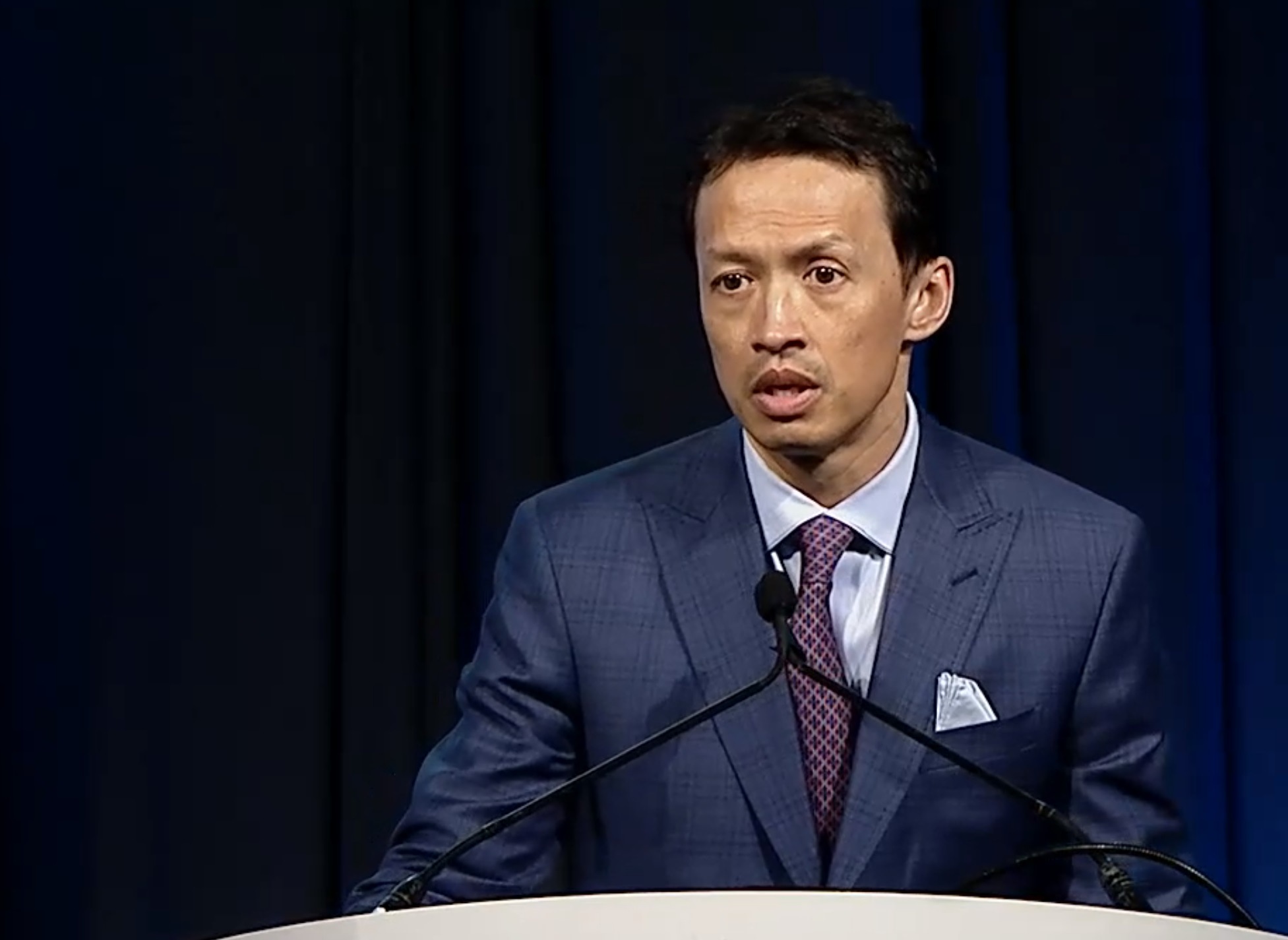
The first procedure has been performed in the US early feasibility study (EFS) assessing the use of the Amend transcatheter mitral annuloplasty system (Valcare Medical), a mitral repair device that is designed to mimic the results seen from a surgical annuloplasty procedure.
The Amend system is a transcatheter device intended for treatment of mitral insufficiency with a semi rigid, closed, D-shaped annuloplasty ring.
“The attractive parts about Amend versus other annuloplasty devices is the more simplistic approach by which it anchors,” Paul Sorajja (Banner – University Medical Center, Phoenix, USA), who performed the procedure, tells Cardiovascular News. “Other devices march around the anulus, whereas the Amend ring cinches front-to-back, anterior to posterior, which is what we try to achieve from a physiological standpoint because it’s a front-to-back enlargement where the leaflets come apart.”
The AMEND TS EFS is evaluating the safety and functionality of the Amend transseptal system in the treatment of subjects with symptomatic moderate-to-severe (3+) or severe (4+) functional mitral regurgitation (FMR) that are anatomically suitable for transcatheter mitral annuloplasty.
The EFS is slated to enrol up to 15 patients in seven investigational centres in the USA, and is expected to pave the way for a pivotal study anticipated in 2027.
The primary and secondary endpoints of the trial include safety and device performance assessments such as technical success of ring delivery, implantation, and delivery system retrieval. Patient outcomes such as stroke, myocardial infarction (MI), non-elective cardiovascular surgery for device related complications, and all-cause mortality are to be reported at 30 days and six months post implantation.
Additional secondary endpoints include changes in New York Heart Association (NYHA) functional class, six-minute-walk-test, quality of life at 30 days and six months in addition to reduction of MR grade from baseline by at least 1 grade at 30 days, six months and one year.
The first patient treated in the trial had atrial functional MR, Sorajja explains to Cardiovascular News, making them an “ideal candidate” the treatment. Use of the semi-rigid ring preserves future treatment options, should further intervention be needed, he comments.
“The technology itself can be used for all patients with MR. If you have organic pathology, you might have to do a clip or a chord. If you have more secondary MR, where the LV [left ventricle] dilates further, you might start with the ring to get the AP [anteroposterior] diameter down, and if you don’t like it, you could either do a clip or even a valve.”
Commenting on the procedure, Steve Sandweg, chief executive officer of Valcare Medical, said: “Annuloplasty has served as the foundation of more than 95% of surgical mitral valve repairs for decades. Applying this proven surgical technique through a percutaneous, transcatheter approach represents a significant step forward. We are grateful to Dr Sorajja, Banner Health, and all participating investigators and their teams for helping bring this important therapy one step closer to patients suffering from significant functional mitral regurgitation.”