Results of the FAST III trial have demonstrated the non-inferiority of coronary revascularisation guided by angiography-based vessel fractional flow reserve (CAAS vFFR) compared to pressure wire-based fractional flow reserve (FFR).
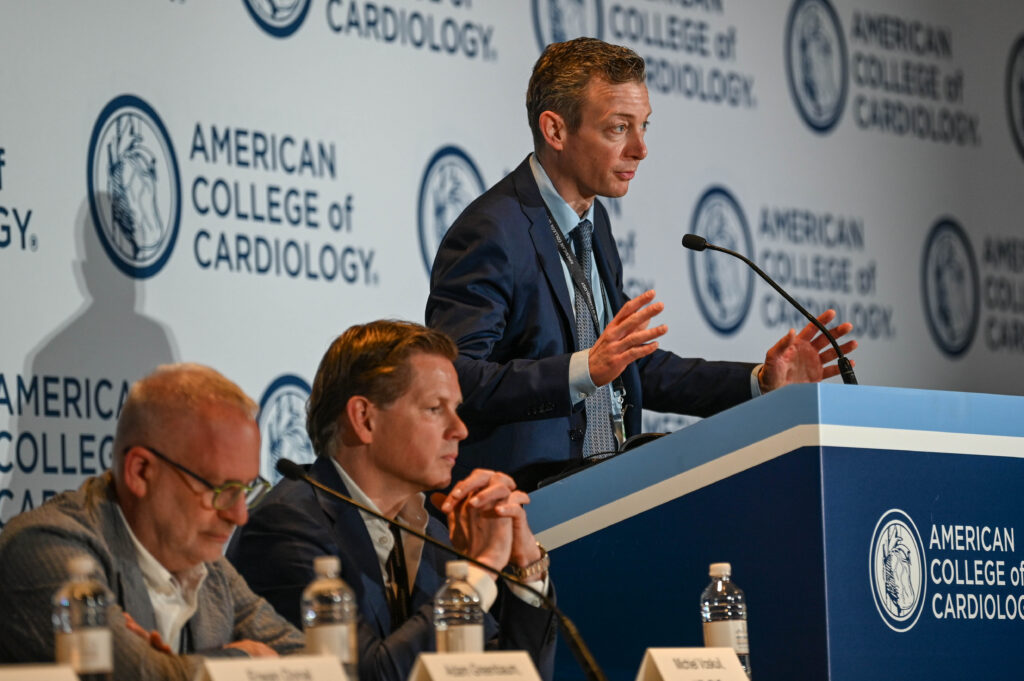
Joost Daemen (Erasmus University Medical Center, Rotterdam, the Netherlands) presented these headline findings during a late-breaking clinical trials session at the 2026 congress of the American College of Cardiology (ACC.26; 28–30 March, New Orleans, USA), with the results of the trial also published in the New England Journal of Medicine.
CAAS vFFR (Pie Medical) is a non-invasive, angiography-based method for calculating FFR values, billed as a faster and easier physiological lesion assessment tool, compared to invasive, wire-based techniques. Traditional FFR utilises a specialised guide wire to measure pressure differences across a coronary stenosis. CAAS vFFR is an alternative method of assessing coronary physiology and calculate FFR values, indicating the significance of specific coronary lesions and showing where blood flow is limited.
FAST III was an investigator-initiated, open label, multicentre randomised trial in which investigators assessed the software to FFR-guided coronary revascularisation in 2,235 patients with intermediate coronary lesions (defined as 30–80% stenosis by visual assessment or quantitative coronary angiography). Intermediate lesions were physiologically assessed using table side vFFR or FFR and treated if vFFR or FFR ≤0.80.
The primary endpoint of the trial was a composite of all-cause death, any myocardial infarction (MI), or any revascularisation at one-year post-randomisation.
At ACC.26, Daemen reported that in both groups, 7.5% of patients experienced a primary endpoint event. The key secondary endpoint of study vessel failure occurred in 4% of patients in the vFFR group vs. 4.6% in the conventional FFR group.
“The results of FAST III confirm the safety and feasibility of the online use of vFFR as an easy to use minimally invasive tool to guide revascularisation in patients with intermediate coronary artery lesions in need of physiological lesion assessment,” said Daemen. “The technology has the potential to boost the use of physiology, which may increase the prognosis of patients in whom the decision to revascularise intermediate coronary artery lesions is still largely based on eyeballing. The use of vFFR eliminates the need for guiding catheters, invasive coronary artery instrumentation and hyperemic agents with inherent risks and patient discomfort.”
A limitation of the study is that it was not blinded, Daemen said—that is, patients and treating physicians knew whether patients had received conventional FFR or vFFR. Another limitation is that only 19% of the patients presented with a heart attack. As a next step, Daemen and his colleagues plan to analyse whether vFFR generates cost savings compared with conventional FFR.
The trial is funded by research grants from Pie Medical Imaging and Siemens Healthineers AG, and sponsored by the European Cardiovascular Research Institute. Cardialysis is responsible for trial services including trial management and core laboratory activities.
“FAST III marks a defining moment. It confirms angiography-based physiology is non-inferior to conventional pressure wire-based physiology,” Bas Kuppens, CEO at Pie Medical Imaging commented of the results. “Additionally, it has demonstrated benefits for care givers and patients by requiring less dose, less contrast agent, and reducing procedure lead time”.
Doris Pommi, head of Cardiovascular Care at Siemens Healthineers, added: “The results of the FAST III study mark a significant milestone for cardiovascular care in Europe and for our partnership with Pie Medical Imaging. Its success shows how much we can achieve when we join forces and combine scientific excellence, clinical experience, and industrial innovation. (The patient impact of the study is substantial, we are looking at safer, faster, less uncomfortable coronary assessments with potentially lower costs and wider access to physiologic lesion evaluation).”